
Understanding Fault When a Parasailing Ride Goes Wrong Off Ft Lauderdale
Key Takeaways:When a parasailing accident occurs in Ft Lauderdale, liability falls on whoever’s negligence caused the harm, often involving multiple parties including the operator, vessel captain, equipment manufacturer, or property owner. Claims rest on negligence law requiring proof of duty and breach, though defective gear adds products liability theories under Fla. Stat. § 768.81(1)(c). Florida apportions damages by each party’s fault percentage, and your contributory fault reduces recovery proportionally, but under HB 837 claimants more than 50 percent at fault cannot recover. Government entities can be sued under Fla. Stat. § 768.28, but recovery caps at $200,000 per person with strict pre-suit notice requirements. Most negligence claims after March 24, 2023 face a two-year deadline under Fla. Stat. § 95.11, making prompt action essential.
When a parasailing excursion in Ft Lauderdale ends in injury, liability falls on whoever’s negligence caused the harm, often with multiple parties sharing blame. A ride above the Atlantic can turn dangerous because of a frayed towline, inattentive captain, defective harness, or inadequate safety briefing. Determining liability is complex because Florida law allows injured riders to pursue every party whose carelessness contributed. Understanding parasailing accident liability Florida rules is the first step toward securing compensation.
Prompt action helps preserve time-sensitive evidence. The team at Chalik & Chalik Injury Lawyers handles boating accidents Ft Lauderdale victims face. Reach out at 954-476-1000 or through the online case review page.
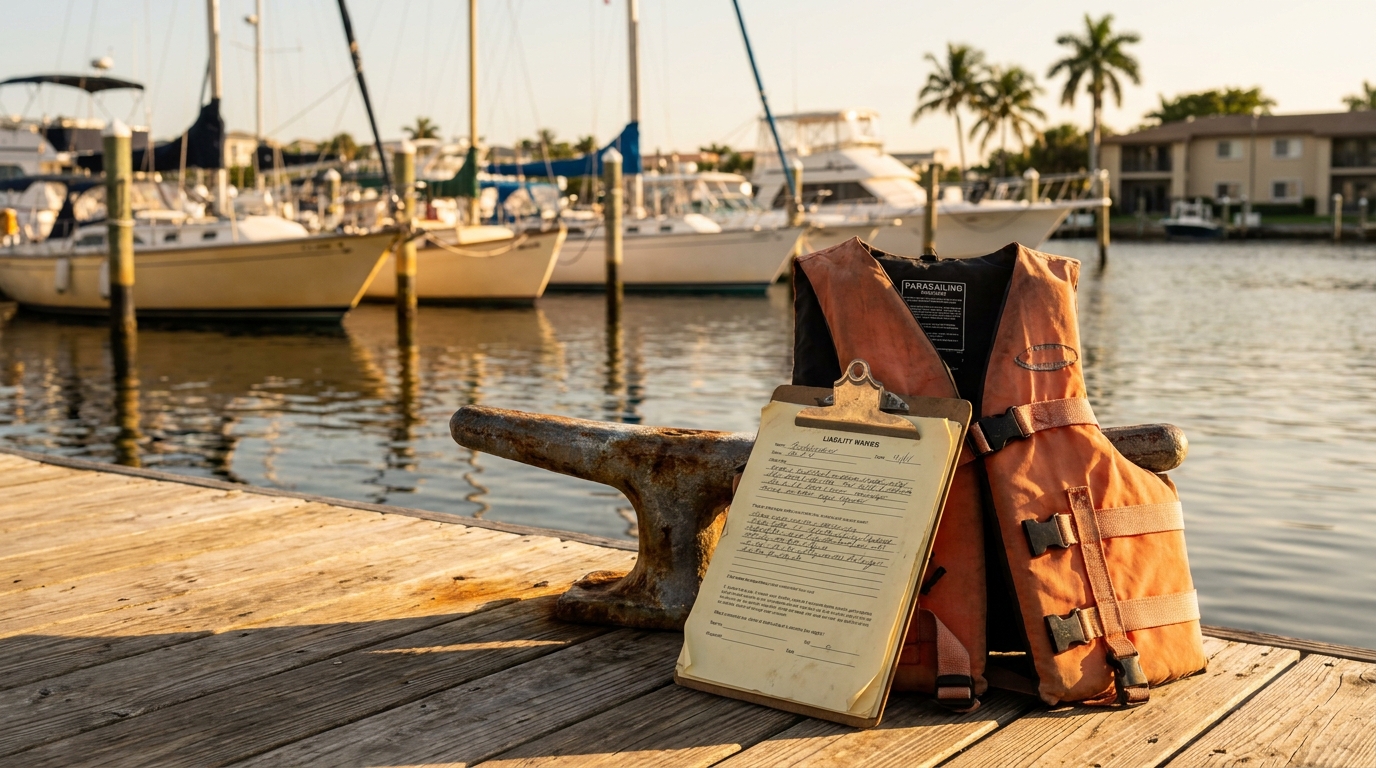
Who Can Be Held Responsible After a Ft Lauderdale Parasailing Accident
Multiple parties may share responsibility, and identifying each affects your recovery. Legal responsibility depends on whose negligence caused the accident. Thorough investigation often reveals fault spans multiple parties: the parasailing operator, vessel captain, equipment manufacturer, or boat and property owner.
Anyone who owns or controls an operation can be liable when dangerous conditions cause injury. Duty of care arises when a responsible party knew or should have known about hazards, worn towlines, overloaded harnesses, or unsafe weather conditions.
Common parties examined in Ft Lauderdale parasailing injury claims:
| Potentially Liable Party | Typical Basis for Liability |
|---|---|
| Parasailing operator | Failure to inspect equipment, ignoring weather, inadequate training |
| Vessel captain | Negligent boat handling, excessive speed, poor judgment |
| Equipment manufacturer | Defective harness, towline, or canopy under a products theory |
| Boat or property owner | Allowing an unsafe operation to continue |
💡 Pro Tip: Photograph equipment, vessel name and registration, and weather conditions before leaving the scene. This evidence disappears quickly once operators learn of potential claims.
The Role of Equipment Failure in These Claims
Defective gear can transform operator claims into shared-liability cases involving manufacturers. Florida law defines negligence actions to include strict liability, products liability, and breach of warranty under Fla. Stat. § 768.81(1)(c). When harness clips snap or towlines fail, injured riders may pursue both the operator and the manufacturer. These overlapping theories make equipment review critical.
Proving Parasailing Operator Negligence
Most Florida parasailing injury claims rest on negligence law, requiring proof of duty and breach. Negligence is failing to act as a reasonably careful person would. To hold operators accountable, injured riders must show the operator owed a safety duty, failed to meet that standard, and caused the injury.
Parasailing operator negligence takes many forms. Common examples include launching in high winds, failing to maintain aging equipment, overloading beyond safe weight limits, and inadequate passenger briefings. Florida has tightened industry oversight, read more about Florida parasailing regulations.
💡 Pro Tip: Request operator inspection and maintenance logs early. Incomplete or missing records may demonstrate breach of duty.
How Florida Handles Parasailing Accident Liability Florida Claims and Shared Fault
Florida apportions damages by each party’s fault percentage rather than joint liability. Under Fla. Stat. § 768.81(3), courts enter judgment against each liable party based on their fault percentage. If an operator is 70 percent at fault and a manufacturer 30 percent, each pays only their share. Identifying every responsible party is essential for full recovery.
Your own conduct can reduce or eliminate recovery. Under Fla. Stat. § 768.81(2), contributory fault diminishes damages proportionally. Since Florida’s 2023 HB 837 tort reform, the state follows modified comparative negligence: claimants more than 50 percent at fault cannot recover any damages. Even if operators argue you ignored instructions, you may recover reduced amounts if your fault doesn’t exceed 50 percent. Review contributory fault provisions for full statutory language.
Defendants often shift blame to nonparties. Under Fla. Stat. § 768.81(3)(a), defendants must affirmatively plead nonparty fault and prove it by preponderance of evidence. Parasailing companies use this defense to reduce exposure, making early anticipation important.
💡 Pro Tip: Don’t give recorded statements to operator insurers before understanding comparative fault. Insurers use your words to inflate your blame percentage and reduce awards.
When a Government Entity Contributes to the Accident
Florida allows suits against government agencies for negligence within strict limits. Under Fla. Stat. § 768.28, the state waives sovereign immunity only as specified. This matters if public marinas, harbor authorities, or public bodies contributed to unsafe conditions.
Recovery against government defendants is capped. The statute limits payment to $200,000 per person and $300,000 per incident, with amounts above requiring legislative claims bills. Review the tort liability statute for exact terms.
Strict Notice Rules for Public Defendants
Claims against government entities require written pre-suit notice separate from lawsuits. Under Fla. Stat. § 768.28(6)(a), claimants must present written claims to the appropriate agency and Department of Financial Services within three years before filing suit. This administrative notice is distinct from lawsuit deadlines, and courts strictly enforce these rules. Missing this step defeats otherwise valid claims.
Deadlines That Affect Your Ft Lauderdale Parasailing Injury Claim
Florida sets firm deadlines for injury lawsuits, and missing them permanently bars claims. Fla. Stat. § 95.11 governs limitations for personal injury and wrongful death claims. For negligence claims accruing after March 24, 2023, HB 837 reduced the period from four years to two years.
The applicable deadline depends on when injury occurred. The older four-year period applied before reform; most current claims carry two-year windows. Narrow exceptions like tolling or delayed discovery may apply in limited circumstances, but courts interpret these narrowly. Confirm your specific deadline early.
💡 Pro Tip: Treat the two-year period as your deadline unless a lawyer confirms otherwise. Waiting can cost you the right to sue.
Serious and fatal incidents make deadlines critical for surviving families. Fla. Stat. § 95.11 also governs wrongful death actions. Families failing to file within statutory windows lose recovery rights. For broader guidance, see this Florida boating accident lawyer overview.
Frequently Asked Questions
-
Who is usually liable for a parasailing accident in Ft Lauderdale?
Liability depends on whose negligence caused the accident. The operator, captain, equipment manufacturer, or property owner may each bear fault, and Florida law allows pursuing all responsible parties.
-
Can I still recover if I was partly at fault?
Yes, if you weren’t mostly to blame. Under Fla. Stat. § 768.81(2), damages are reduced by your fault percentage, but claimants more than 50 percent at fault cannot recover under HB 837’s modified comparative negligence rule.
-
How long do I have to file a parasailing injury lawsuit?
Most negligence claims after March 24, 2023 carry a two-year deadline under Fla. Stat. § 95.11. Limited exceptions exist but are narrowly interpreted, so confirm your deadline promptly.
-
What if a defective harness or towline caused my injury?
You may have products liability claims alongside negligence claims. Fla. Stat. § 768.81(1)(c) defines negligence actions to include strict liability, products liability, and breach of warranty theories.
-
Can I sue a government entity involved in the accident?
Sometimes, but with capped recovery and strict notice requirements. Fla. Stat. § 768.28 waives sovereign immunity within limits, requiring written pre-suit notice before filing.
Protecting Your Rights After a Parasailing Injury
Determining liability for parasailing accidents in Ft Lauderdale requires examining negligence, shared fault, equipment defects, and filing deadlines. Florida’s comparative fault system means every responsible party matters, while short limitations periods make delay costly. Understanding applicable statutes early strengthens your position for fair compensation.
You don’t have to navigate these rules alone. The attorneys at Chalik & Chalik Injury Lawyers are trusted throughout the region. Start a conversation about your options by calling 954-476-1000 or using the firm’s confidential contact form. Prompt action protects both evidence and legal rights.


On August 18, 2007, in Pompano Beach Florida, a young girl’s life was tragically taken away from her as a result of the negligence of a parasailing operator. Amber May White, age 15, and her sister Crystal White, age 17, of Summerfield, Florida, were staying at the Wyndham Resort on Pompano Beach, enjoying their last...

As of June 2014, the White-Miskell Act is law in Florida. With Governor Scott’s signature, it feels as if a hard fought battle has finally been won. We didn’t get everything we wanted or need, but after seven years of trying, Florida citizens at least have some minimal protection against those parasailing operators who put...

A speedboat guiding parasailers up and down the beach is as common a sight in Florida as the fishing boats that patrol the coastal waters. Unfortunately, the fish in the ocean enjoy many more protections than the people who climb aboard one of Florida’s more than 100 unregulated parasailing vessels. Parasailing – a popular tourist...

Thank you Advocate Capital for helping us spread the word about the dangers of parasailing. Changes these regulations is something we feel very strongly about and are working hard to get the message out to the right people. As many of our clients know, we joined the efforts of the White family back in 2007...