
The Invisible Crosswalks Most Florida Drivers Forget Exist
Key Takeaways:Under Fla. Stat. §316.003(17), an unmarked crosswalk is generally the part of a roadway at an intersection formed by connecting the lateral lines of sidewalks on opposite sides of the street, paint, signage, or a signal is not necessarily required. Drivers generally owe the same duty to yield at these crossings under Fla. Stat. §316.130(7), along with related obligations at red lights and stop signs and a prohibition under §316.130(9) on passing a vehicle stopped for a pedestrian. Those protections aren’t unlimited: pedestrians crossing mid-block may be required to yield to traffic under §316.130(10) and shouldn’t suddenly step into the path of a vehicle too close to stop under §316.130(8). The practical difficulty in these Ft. Lauderdale claims is often proving where the crossing occurred, which may depend on surveillance video, event data recorder downloads, aerial imagery, scene measurements, and witness statements that can fade quickly. Insurers frequently raise comparative fault arguments under Fla. Stat. §768.81, and PIP limits may not cover a serious pedestrian injury in full. Prompt medical care, careful handling of recorded statements, and early evidence preservation may help protect available options.
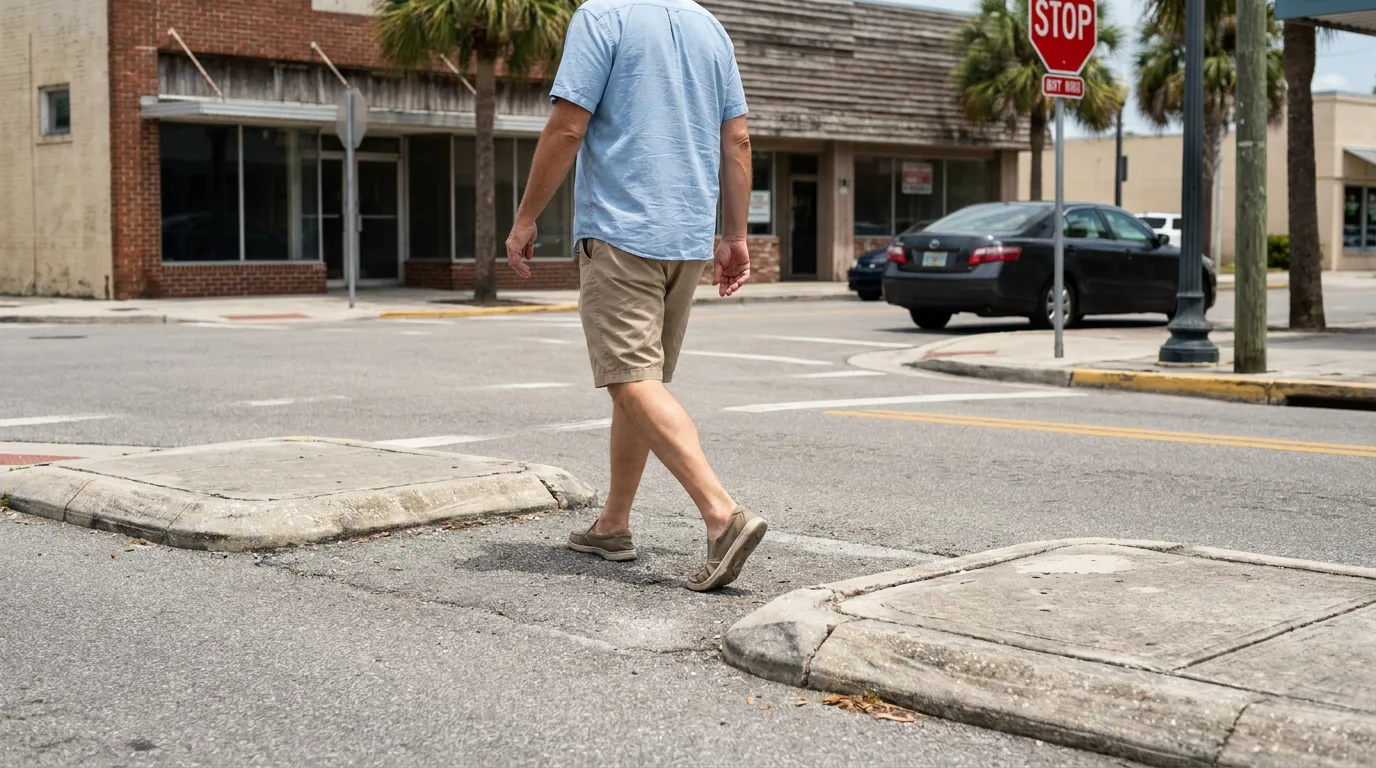
An unmarked crosswalk is generally a legally recognized pedestrian crossing that can exist at an intersection even without painted lines. Where sidewalks meet a roadway at an intersection, the imaginary extension of those sidewalk lines across the pavement may constitute a crosswalk. Pedestrians crossing there generally retain the same right-of-way protections as those inside painted stripes, which matters in Ft. Lauderdale, where many residential intersections have sidewalks but no paint.
If you or a loved one were struck while crossing at an intersection, the team at Chalik & Chalik Injury Lawyers can review how Florida crosswalk law applies to your facts. Call 954-476-1000 or contact us now to discuss your options with a Ft. Lauderdale pedestrian accident attorney.
What Is an Unmarked Crosswalk Under Florida Statute 316.003?
The crosswalk definition in Florida law is broader than most people assume. Fla. Stat. §316.003(17) defines a crosswalk two ways: first, the part of a roadway at an intersection within the connections of the lateral lines of sidewalks on opposite sides, measured from the curbs or edges of the roadway; second, any portion distinctly marked for pedestrian crossing. Because the Legislature periodically renumbers definitions within §316.003, confirm the subsection against the current statute.
That first definition is generally understood as the statutory source of the unmarked crosswalk. It requires no paint, signage, or signal, only an intersection where sidewalk lines on opposite sides can be connected. In many Broward County neighborhoods, a crossing you assumed was unprotected may carry statutory recognition under the state’s traffic control chapter.
Marked vs Unmarked Crosswalk: What Actually Changes
Legally, far less may change than drivers and adjusters often suggest. The duty to yield under Fla. Stat. §316.130(7)(c) applies to a pedestrian "crossing the roadway within a crosswalk," without limiting that to painted crossings. What often differs in practice is visibility, driver expectation, and the evidentiary work required to prove where the crossing occurred.
| Feature | Marked Crosswalk | Unmarked Crosswalk |
|---|---|---|
| Statutory basis | Fla. Stat. §316.003(17) | Fla. Stat. §316.003(17) |
| Driver duty to yield | Fla. Stat. §316.130(7) | Fla. Stat. §316.130(7) |
| Requires an intersection | Not necessarily | Yes |
| Visual notice to drivers | High | Often low |
| Proof burden after a crash | Usually simpler | Frequently disputed |
The Unmarked Crosswalk Right of Way Florida Drivers Must Respect
The central rule appears in Fla. Stat. §316.130(7)(c). When signals aren’t operating and no signage says otherwise, a driver must yield, slowing or stopping if needed, to a pedestrian crossing within a crosswalk when that pedestrian is on the driver’s half of the roadway or approaching closely enough from the other half to be in danger. Because §316.003(17) supplies the definition, this obligation may reach unmarked intersection crossings.
Signalized intersections may layer additional duties. Under Fla. Stat. §316.130(7)(a), a driver at a signal-controlled intersection must stop before entering the crosswalk and remain stopped for a pedestrian with a permitted signal under the same proximity conditions, and Fla. Stat. §316.075(1)(c) separately requires stopping before the crosswalk on a steady red signal. Stop-sign intersections work similarly: Fla. Stat. §316.123(2)(a) requires stopping at a marked stop line, or if none exists, before entering the crosswalk. These provisions generally treat unpainted areas as real legal boundaries, though whether a crosswalk existed remains a fact question.
Florida law also addresses one of the deadliest crash patterns for pedestrians. Fla. Stat. §316.130(9) prohibits passing a vehicle stopped at a marked or unmarked crosswalk to permit a pedestrian to cross. These multiple-threat collisions frequently occur on multi-lane Ft. Lauderdale corridors, where a courteous driver stops while a second driver accelerates past in the adjacent lane.
Where Pedestrian Right-of-Way Ends
The protections aren’t unlimited. Fla. Stat. §316.130(10) provides that a pedestrian crossing anywhere other than within a marked crosswalk or an unmarked crosswalk at an intersection must yield to vehicles on the roadway. This is precisely why the intersection element matters. Mid-block crossings generally shift the obligation onto the pedestrian, and §316.130(11) further provides that between adjacent intersections with operating signals, pedestrians may cross only in a marked crosswalk.
Pedestrians carry duties inside crosswalks too. Fla. Stat. §316.130(8) states a pedestrian shall not suddenly leave a place of safety and walk into the path of a vehicle too close to yield. Insurers routinely raise this in comparative fault arguments, and whether it applies may depend on distance, speed, sight lines, and timing. A statutory violation by either party is generally evidence of negligence rather than an automatic determination of liability.
💡 Pro Tip: If you were injured at an intersection with no paint, photograph the sidewalk approaches on both sides of the road, not just the impact point. Those sidewalk lines generally help establish that an unmarked crosswalk existed there.
Common Challenges in Ft. Lauderdale Unmarked Crosswalk Claims
Proving the geometry of the crossing is often the first battleground. Because nothing on the pavement records where the crosswalk begins and ends, defense arguments frequently claim the pedestrian was crossing mid-block or outside the sidewalk extension. Useful evidence includes:
- Surveillance footage from nearby homes, businesses, or transit facilities
- Vehicle event data recorder downloads showing speed and braking
- Aerial or street-level imagery documenting sidewalk placement
- Roadway measurements and scene diagrams prepared before conditions change
- Independent witness statements taken while memories remain fresh
Much of this evidence can disappear quickly. Surveillance systems commonly overwrite within days or weeks, and vehicles are repaired or sold. Acting early generally preserves more options, though outcomes always depend on the particular facts. Readers weighing whether a driver breached a duty may find it useful to review when a driver is liable for hitting a pedestrian.
Comparative Fault and Insurance Pressure
Florida applies comparative fault principles under Fla. Stat. §768.81, and adjusters know it. For most claims accruing on or after March 24, 2023, Florida uses a modified comparative negligence standard barring recovery for a claimant found more than 50 percent at fault; earlier claims are generally governed by the prior pure comparative negligence rule. A carrier may argue the injured person darted out, wore dark clothing, or ignored an available signalized crossing. These arguments are fact-dependent, and courts may weigh lighting, driver attention, vehicle speed, and lookout.
PIP benefits may not cover a serious pedestrian injury in full. A struck pedestrian generally looks first to PIP under his or her own auto policy, or a resident relative’s policy, and PIP limits under Fla. Stat. §627.736 can be exhausted rapidly by emergency transport, imaging, and surgical care. Whether additional recovery is available against a driver or other party depends on the injuries, applicable coverage, and strength of the liability evidence.
💡 Pro Tip: Ask the responding agency how to obtain the crash report and confirm how the diagram depicts your crossing position. Diagrams are sometimes drawn from incomplete information and can be supplemented by other evidence.
Practical Steps After an Intersection Collision
What you do in the first days can shape the entire claim. Seek medical evaluation promptly, even if symptoms feel manageable, since delayed treatment is frequently used to challenge causation, and PIP benefits generally require initial services within 14 days of the crash. Report the crash, request a copy of the report, and keep every bill, referral, and work absence record organized.
Be cautious with recorded statements. Insurance representatives may call quickly, asking questions designed to elicit admissions about speed, attention, or where you stepped into the road. While your own insurer may have contractual cooperation rights, you’re generally not required to give a recorded statement to another driver’s carrier before understanding your rights. Speaking with a Ft Lauderdale pedestrian accident attorney beforehand may help you avoid unintended concessions.
These rules interact as a system. Related provisions at Fla. Stat. §316.1301 address heightened duties toward pedestrians who are blind or otherwise vulnerable. A single subsection rarely answers a real-world liability question by itself.
Frequently Asked Questions
1. Does an unmarked crosswalk exist at every intersection in Florida?
Not universally. The statutory definition in Fla. Stat. §316.003(17) generally depends on sidewalks existing on opposite sides of the roadway so their lateral lines can be connected. Where no sidewalks exist, the analysis becomes more fact-specific.
2. Can I still recover compensation if I was partly at fault?
Possibly, subject to Florida’s modified comparative fault framework in Fla. Stat. §768.81. Fault allocated to the pedestrian generally reduces recovery proportionally, but for most claims accruing on or after March 24, 2023, being found more than 50 percent at fault bars recovery entirely. A careful review of the evidence is necessary before any prediction can responsibly be made.
3. What if the driver says there was no crosswalk there?
That assertion is generally a legal conclusion, not a fact. Under Fla. Stat. §316.130(7) and the definition in §316.003(17), the absence of paint doesn’t necessarily eliminate a crosswalk at an intersection. Documentation of sidewalk placement and your crossing path typically helps resolve the dispute.
4. Do drivers have to stop or only slow down?
Fla. Stat. §316.130(7)(c) requires slowing down or stopping if necessary to yield. At crosswalks with signage or a signal, §316.130(7)(a) and (b) require stopping and remaining stopped under those provisions’ circumstances. The obligation generally triggers when the pedestrian is on the driver’s half of the roadway or approaching closely enough from the other half to be in danger, and whether a driver satisfied that duty is fact-dependent.
5. How long do I have to file a claim in Florida?
Civil deadlines vary by claim type. Most negligence claims accruing on or after March 24, 2023, are subject to a two-year limitations period under Fla. Stat. §95.11, while earlier claims were generally governed by a four-year period. Claims involving government entities also involve separate presuit notice requirements under Fla. Stat. §768.28, distinct from the civil lawsuit deadline. Exceptions such as tolling are generally interpreted narrowly, so early legal review is advisable.
Why Unpainted Pavement Still Carries Legal Weight
Florida law generally does not condition pedestrian right-of-way on paint. Through the crosswalk definition in Fla. Stat. §316.003(17) and the yielding duties in Fla. Stat. §§316.130(7), 316.075(1)(c), and 316.123(2)(a), an unmarked crossing at an intersection may carry genuine statutory protection, balanced by pedestrian duties under §316.130(8) and §316.130(10). Understanding the marked vs unmarked crosswalk distinction can help injured people recognize that a missing stripe doesn’t necessarily mean a missing claim, though every outcome depends on the specific facts and available evidence.
If you were hurt while crossing in Broward County, the attorneys at Chalik & Chalik are available to evaluate your situation and explain how these statutes may apply. Call 954-476-1000 or request a case review to get answers about your next steps.
Disclaimer: This content is for informational purposes only and is not legal advice. Every case is unique, and results may vary. Consult an attorney about your specific circumstances.

With over 60,000 serious injuries and nearly 4,000 deaths each year, pedestrian accidents are occurring at an alarming rate. What’s even more shocking is the rate at which these accidents are affecting younger populations. In order to understand the causes of pedestrian accidents and how to prevent them, the National Highway Traffic Safety Administration (NHTSA)...

It seems like every time you turn on the news, there is another story of someone getting hit by a car in South Florida. Just this week, a couple in their eighties were struck and killed by a car in Fort Myers, and two University of Miami students were struck and killed while crossing the...

New Research Shows Distracted Walking Causes South Florida Accidents Almost everyone seems to have a cell phone these days, as popularity for the iPhone and other smartphones is ever increasing. Although the cell phone is a great invention, it seems as if it poses an inevitable threat on the road to those using one. The...

The Orange County Board of Commissioners has approved a $5 million plan to improve pedestrian and bike safety on the major roads serving the University of Central Florida (UCF) campus. The plan includes the building and improving of mid-block crosswalks, sidewalks and bike paths in order to make their use safer and more appealing to...

The person or entity whose negligence led to the pedestrian accident is liable. However, determining the at-fault party requires a thorough investigation and an understanding of what constitutes negligence and how to identify it. Proving these elements and filing your potential lawsuit on time are critical to recovering damages. You do not have to define...

There are several ways pedestrians can seek compensation for their injuries if hit by a car in Florida. If you were the victim of this type of accident, you might be able to file a claim with your own no-fault insurance, with the at-fault driver’s no-fault insurance, or with the motorist’s auto liability policy. If...

Not everyone gets around Fort Lauderdale by car, and even drivers become pedestrians when they use sidewalks and crosswalks to get to their destinations, such as the park, a beach, or a downtown festival, after parking somewhere nearby. Unfortunately, year after year, Fort Lauderdale consistently ranks among the deadliest cities in Florida and the United...