
Understanding Your Right to Hold a Road Agency Accountable
Key Takeaways:A Ft. Lauderdale truck accident victim can potentially sue a government road agency when poor maintenance, defective work zones, or negligent roadway design contributed to the crash, but these claims follow a stricter path than ordinary lawsuits. Florida only partially waives sovereign immunity, requiring special pre-suit notice, imposing damage caps, and demanding rigorous proof of fault. Under Florida’s modified comparative fault system, your responsibility reduces your recovery proportionally and bars it entirely if you exceed 50% fault; each liable party generally pays only its percentage. Defendants may shift blame onto others but must affirmatively plead and prove that fault. Federal crash statistics provide context but cannot establish fault, which requires independent investigation. Acting promptly to preserve evidence and meet strict deadlines is essential.
Yes, a Ft. Lauderdale truck accident victim may sue a government road agency, but these claims follow a different and stricter path than ordinary injury lawsuits. When a poorly maintained road, defective work zone, or negligent roadway design contributes to a crash, the controlling government entity may share responsibility. However, suing a government body in Florida involves sovereign immunity limits, special notice rules, and demanding proof of fault.
If you believe unsafe road conditions played a role in your truck crash, the team at Chalik & Chalik Injury Lawyers is ready to review your situation. Call us at 954-476-1000 or reach out through our online case review form.
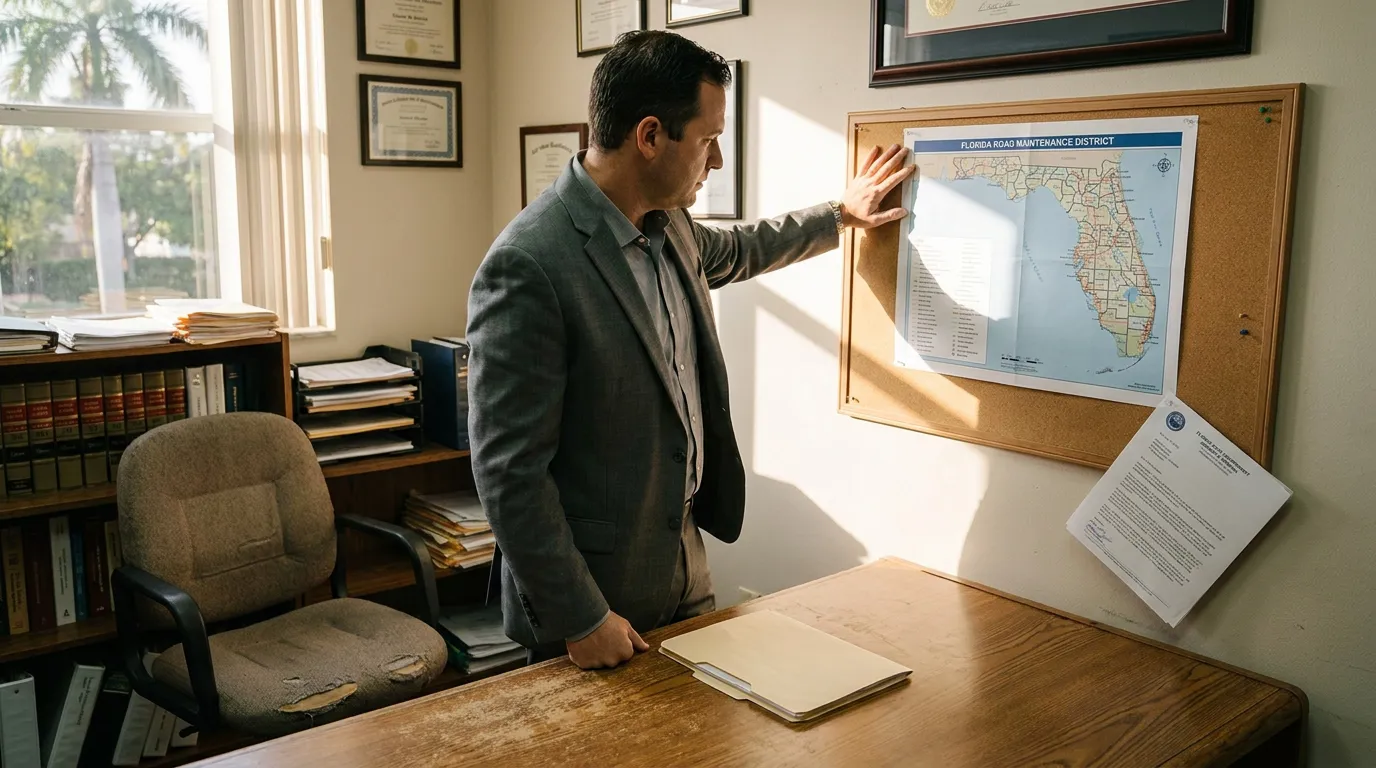
When a Government Road Agency Might Share Fault
A road agency may bear responsibility when its negligence in maintaining or designing a roadway contributes to a truck crash. Government bodies that build, maintain, or manage streets and highways must keep those roads reasonably safe. When they breach that duty through neglected repairs, missing signage, or hazardous construction areas, that breach can support a claim. Note that certain discretionary, planning-level design decisions may remain protected by sovereign immunity, while operational failures such as negligent maintenance are more likely actionable.
Work zones are a common flashpoint. An area with highway construction, maintenance, or utility-work activities is typically marked by signs, channeling devices, barriers, pavement markings, and/or work vehicles. Because public agencies or their contractors frequently manage these zones, a truck accident lawyer in Ft Lauderdale will examine whether the zone was properly designed and marked.
💡 Pro Tip: Photograph the crash scene, including road defects, faded lane markings, and any construction signage, as soon as safe. Road conditions can be repaired quickly, erasing valuable evidence of negligence.
How Florida’s Comparative Fault System Affects Your Claim
Florida uses a modified comparative fault system that reduces recovery based on your own share of responsibility. Under Fla. Stat. §768.81(2), contributory fault diminishes proportionately the damages awarded but does not bar recovery, subject to subsection (6). However, a claimant found more than 50% at fault is barred from recovering any damages, making your fault percentage decisive.
The system also limits each defendant’s payment. Under Fla. Stat. §768.81(3), "the court shall enter judgment against each party liable on the basis of such party’s percentage of fault and not on the basis of the doctrine of joint and several liability." If a government road agency is found partially at fault, it generally pays only its own percentage rather than the full award.
As discussed in analysis of Florida’s approach to apportioning fault, a negligent tortfeasor’s liability is generally limited to his or her own degree of fault, avoiding burdening defendants with liability they did not cause. Because these determinations are fact-dependent, results vary case by case.
How Defendants Try to Shift Blame
Defendants, including government agencies, can attempt to place fault on others, but they must prove it. Florida law allows defendants to plead and prove that a codefendant or nonparty caused a plaintiff’s injuries, potentially reducing their responsibility. This tool can shift fault toward or away from a road agency.
Under Fla. Stat. §768.81(3)(a), a defendant must "affirmatively plead the fault of a nonparty" and "prove at trial, by a preponderance of the evidence, the fault of the nonparty in causing the plaintiff’s injuries." While apportionment in simpler collisions is straightforward, multi-defendant truck cases involving a public entity are far more complex.
💡 Pro Tip: If a trucking company or insurer suddenly blames "the road" or an unnamed party, preserve evidence quickly. Their strategy may be shifting responsibility onto a nonparty.
Using Federal Crash Data to Understand the Risks
Federal crash statistics provide helpful context, though they cannot establish fault in your individual case. The Federal Motor Carrier Safety Administration publishes recurring reports with descriptive statistics about fatal, injury, and property-damage-only crashes involving large trucks and buses, giving victims a credible reference point for understanding crash frequency and severity.
These datasets are useful for context:
- Data on large truck and bus crashes by first harmful event type and roadway type helps distinguish crashes tied to road conditions.
- State crash records can be downloaded by selecting a State from the dropdown, allowing Broward County residents to review localized figures.
- A large truck is defined as a truck with a gross vehicle weight rating greater than 10,000 pounds.
Explore the underlying figures through the large truck and bus crash facts reports released annually.
There is a critical limitation: FARS, GES, CRSS, and FMCSA Crash File describe crash events and details but do not include data on crash causation or fault. Fault against a road agency must be established separately through independent investigation, not from statistics.
💡 Pro Tip: Statistics support a narrative but never replace scene-specific proof. Establishing a road agency’s negligence requires engineering analysis, maintenance records, and inspection histories.
Special Rules When You Sue a Government Entity in Florida
Suing a government entity in Florida triggers sovereign immunity rules and strict pre-suit requirements that do not apply to private defendants. Florida has waived immunity only to a limited degree under Fla. Stat. §768.28, and statutory damage caps and notice deadlines can significantly affect recovery. These government administrative claim requirements are separate from the civil statute of limitations, and courts interpret exceptions narrowly.
Our overview of the current Florida sovereign immunity caps explains how these limits shape a government liability Florida claim. Missing a notice requirement can jeopardize an otherwise strong case.
| Type of Deadline | What It Governs | Key Consideration |
|---|---|---|
| Civil statute of limitations | Time to file a negligence lawsuit | Interpreted strictly; exceptions apply only in limited circumstances |
| Government notice requirement | Pre-suit notice to a public entity | Separate from the civil deadline; may bar suit if missed |
| Damage caps | Maximum recoverable from the state | May limit recovery even when fault is proven; amounts above the cap generally require a legislative claim bill |
Why a Personal Injury Attorney Ft. Lauderdale Victims Rely On Can Help
Government road claims reward preparation, local knowledge, and prompt action. A personal injury attorney Ft. Lauderdale residents turn to can identify the correct public entity, preserve fragile roadway evidence, and meet demanding notice requirements. These cases often require coordinating maintenance records, construction contracts, and roadway design documents.
Our firm advocates only for injured victims and their families, never for insurers or defendants. Connect with a Broward County injury claim lawyer who focuses on plaintiff-side representation. An early consultation helps clarify whether a road agency may share responsibility.
💡 Pro Tip: Keep a dedicated folder for medical bills, correspondence, and crash-related documents. Organized records make evaluating a Ft Lauderdale truck accident claim easier and protect against missed deadlines.
Frequently Asked Questions
-
Can I really sue a city or state agency after a truck crash?
You may be able to, if a public entity’s negligence in maintaining or designing the road contributed to the crash. However, sovereign immunity, damage caps, and pre-suit notice rules apply, and courts construe these limits narrowly.
-
Does my own fault stop me from recovering damages?
Not necessarily. Under Fla. Stat. §768.81(2), your contributory fault proportionally reduces your award but does not bar recovery. However, if you are found more than 50% at fault, you are barred from recovering damages.
-
Will a government agency pay for all my damages if it caused the crash?
Generally no. Under Fla. Stat. §768.81(3), each liable party pays based on its own percentage of fault, and statutory caps may further limit recovery from a public entity.
-
Can federal crash statistics prove the road agency was at fault?
No. Federal crash databases describe crash events but do not record causation or fault. Establishing an agency’s negligence requires independent investigation specific to your crash.
-
How quickly should I act on a government road claim?
As soon as possible. Government notice requirements are separate from the civil statute of limitations, and missing either deadline can jeopardize your claim. Road conditions may also be repaired quickly, so early evidence preservation matters.
Protecting Your Rights After a Truck Crash Involving Road Conditions
Holding a government road agency accountable is possible in Florida, but it demands careful attention to fault, statutory limits, and strict deadlines. Between the comparative fault rules of Fla. Stat. §768.81, sovereign immunity caps, and the burden of proving negligence with scene-specific evidence, these claims are among the more complex in personal injury Florida practice. Understanding the difference between crash data and actual proof of fault, along with separate deadlines, can meaningfully affect your case outcome.
If unsafe road conditions or a hazardous work zone contributed to your injuries, do not wait to protect your rights. Contact Chalik & Chalik Injury Lawyers today by calling 954-476-1000 or using our confidential contact page to request a review of your Ft Lauderdale truck accident claim.
 What Are Florida’s Hours of Service Rules for Truck Drivers?
Understanding the Driving Limits That Keep Fort Lauderdale Roads Safer Key Takeaways: Florida truck drivers generally follow one of two hours of service frameworks depending on where they operate. Interstate drivers typically fall under FMCSA rules in 49 C.F.R. Part 395, capping driving at 11 hours after 10 consecutive hours off duty, imposing a 14-hour...

Accidents involving garbage trucks can cause injuries to other motorists, pedestrians, cyclists, children, and even garbage truck workers themselves. When the term “truck accident” is used, the image that comes to mind most often is one of a tractor-trailer colliding with a passenger vehicle on the highway. However, there are other types of truck accidents...
 Which Truck Accident Types Are Most Common in Ft Lauderdale?
Understanding Truck Crash Patterns Across Broward County Key Takeaways: The most common truck accident types in Ft Lauderdale include rear-end and underride collisions, jackknife and rollover crashes, and blind-spot and wide-turn wrecks, driven by commercial vehicle size, dense traffic, and limited visibility. These patterns cluster on busy corridors like I-95 and I-595 where freight, tourism,...

Aggressive driving plays a role in about one-third of all auto accidents each year in the U.S. That means aggressive driving is at least a factor in nearly 1,000 deaths and 150,000 injuries each year. Aggressive driving on the part of truck drivers, which involves negligent actions that put others in danger, can cause many...

Although not many truck accident statistics specific to Fort Lauderdale are available, we know truck accidents are often immensely dangerous. The Federal Motor Carrier Safety Administration (FMCSA) data shows that for one specific year, large trucks and buses accounted for 13.2% of fatal accidents in the United States. Trucks are a staple of Fort Lauderdale, as they...

Florida is among the top three states with the most serious truck accidents, according to the National Safety Council (NSC). According to its report, 373 truck accident victims lost their lives in Florida in 2021, and only Texas and California saw more fatal truck accidents that year. If you or a loved one was in...

When an insurance claim has been denied, you can appeal the decision. The process begins with receiving a denial letter from the insurance company. In this letter, the steps for filing an appeal should be within the letter, with the name of the claims adjuster or point of contact. First, notify the insurer of your...

You can sue someone personally after a truck accident, but this is just one of several options to consider. To understand your options for seeking the money you deserve (and which option may be best for you), consider hiring a Fort Lauderdale truck accident lawyer from our team. We can take legal action on your...