
Why Government Airport Claims Follow Different Rules
Key Takeaways:Preserving a Miami airport accident claim against a government entity requires satisfying strict notice rules and deadlines. Miami International Airport is government-operated, so Florida’s limited sovereign immunity waiver under § 768.28 requires mandatory written pre-suit notice within 3 years of accrual (2 years for wrongful death) before filing suit. You must also meet separate civil filing deadlines; for negligence claims accruing on or after March 24, 2023, the 2-year limitation generally controls. Quick action to document conditions, secure incident reports, identify witnesses, and preserve security footage protects the duty, breach, causation, and damages elements of your claim. Recovery is shaped by modified comparative negligence (barring claimants over 50 percent at fault) and damage caps of $200,000 per person and $300,000 per incident absent legislative action.
Preserving a claim after injury at a government-operated Miami airport requires fast, deliberate action because ordinary private lawsuit rules do not fully apply. Miami International Airport is operated by a governmental entity, triggering special notice requirements, shorter deadlines, and liability caps. If you were hurt in a terminal fall, shuttle collision, or baggage-claim incident, steps taken in the first weeks can determine whether you retain the right to recover. This guide walks through those steps while pointing to controlling Florida statutes.
Every case turns on its own facts, and this article offers general legal information rather than individualized advice. For questions about a specific incident, speak with a qualified attorney promptly. Chalik & Chalik Injury Lawyers is available to help injured travelers understand their options. Reach the firm through Chalik & Chalik Injury Lawyers, call 954-476-1000, or use the online contact form.
Sovereign Immunity and Why It Limits Government Airport Claims
Sovereign immunity historically shielded governments from lawsuits and still shapes every government negligence claim in Florida. Florida has agreed to be sued only within statutory limits. The state waives sovereign immunity for tort liability to the extent specified in the statute, and state agencies or subdivisions include counties and municipalities. That waiver allows injured persons to pursue governmental entities operating Miami airports.
The waiver is narrow and that distinction matters when evaluating cases. General premises-liability principles apply alongside statutory conditions unique to government defendants. The governing framework appears in Florida’s limited waiver statute, reviewable through Florida sovereign immunity statute. This backdrop explains why procedural steps are non-negotiable.
Who May Be Responsible for an Airport Injury
Identifying the correct defendant early is critical because multiple parties may share responsibility. Airport injuries can involve the governmental operator, airlines, cleaning contractors, retail vendors, or shuttle companies. Sorting roles matters because notice rules apply specifically to government entities, while private parties follow ordinary procedures. Missing a public defendant can forfeit part of your recovery.
The Florida 768.28 Notice of Claim Requirement
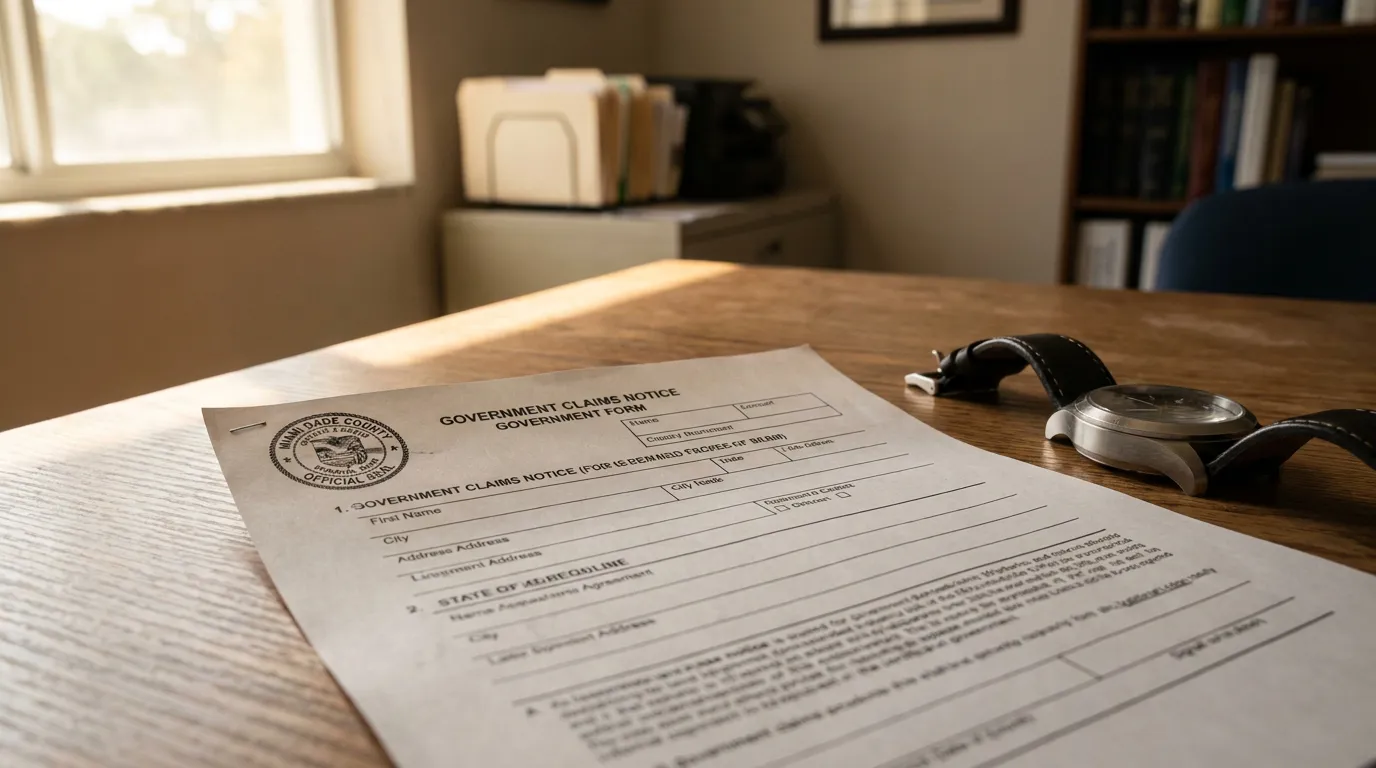
Written pre-suit notice is a mandatory condition precedent, you generally cannot file suit against a government airport operator without completing it. An action may not be instituted unless the claimant presents the claim in writing to the appropriate agency. This is the heart of the florida 768.28 notice of claim process, and courts treat it strictly.
Notice must reach correct recipients within defined windows. Claims must be presented in writing to the appropriate agency and, except for municipalities and counties, to the Department of Financial Services within 3 years after accrual, with denial required before suit. For wrongful death, claimants must present claims within 2 years of accrual.
The government’s response, or lack thereof, can open the courthouse door. Failure to make final disposition within 6 months is deemed denial, letting claimants proceed to suit. Because these rules are precise, many injured people work with a florida 768.28 notice of claim lawyer to confirm notice is complete and correctly delivered.
💡 Pro Tip: Keep proof of delivery for every notice. A dated receipt or certified-mail confirmation can later prove you satisfied the statutory condition if timing is disputed.
Deadlines That Can Make or Break Your Claim
Meeting notice requirements does not end obligations because separate lawsuit deadlines still apply. Every claim shall be forever barred unless civil action commences within 4 years after accrual, with medical malpractice and wrongful death governed by their own periods. Pre-suit notice and civil filing deadlines are distinct, both must be satisfied. For negligence claims accruing on or after March 24, 2023, the shorter 2-year limitations period generally controls filing time.
Florida’s general negligence deadline changed recently. Under 2023 HB 837 tort reform, the statute of limitations for negligence was reduced from four to two years for causes accruing on or after March 24, 2023. Florida Statute 95.11 establishes these deadlines, reviewable through Florida statute of limitations.
Tolling and delayed-discovery arguments exist but courts interpret exceptions narrowly. Extensions apply only in limited circumstances and do not attach automatically. Treat every deadline as firm unless a court confirms otherwise.
| Requirement | General Timeframe | Source |
|---|---|---|
| Written notice to agency (most claims) | Within 3 years of accrual | § 768.28(6)(a) |
| Written notice for wrongful death | Within 2 years of accrual | § 768.28(6)(a)2. |
| Agency deemed denial | After 6 months of no disposition | § 768.28(6)(d) |
| Civil action against government | Within 4 years of accrual (2 years for negligence accruing on or after 3/24/2023) | § 768.28(14); § 95.11(4)(a) |
| General negligence (post-3/24/2023) | Within 2 years of accrual | § 95.11(4)(a) |
Preserving Evidence After a Miami Airport Accident
Evidence preservation is where strong claims are built or lost, especially in busy terminal environments. Security footage may be overwritten, spills cleaned, and witnesses scatter within hours. Quick action to document conditions supports the four negligence elements: duty, breach, causation, and damages.
A focused preservation plan protects government negligence claims. Consider these steps as soon as safely able:
- Photograph the hazard, your injuries, and surrounding area including signage and lighting.
- Request the incident report and note names of airport staff involved.
- Identify witnesses and collect contact information before they depart.
- Seek prompt medical care and keep all records; treatment gaps can undercut claims.
- Send written requests asking the airport to preserve security video before recycling.
Expert analysis often becomes necessary, which is why preserving raw evidence matters. Reconstructing moving-walkway malfunctions or flooring defects can require professionals who review original conditions. Strong contemporaneous documentation supports causation effectively.
💡 Pro Tip: Send video-preservation requests in writing and keep copies. Once footage is overwritten, it’s generally unrecoverable, and documented requests show diligence.
How Fault and Damage Caps Affect Recovery
Florida uses modified comparative negligence that can eliminate recovery for heavily at-fault claimants. Any party found greater than 50 percent at fault may not recover damages. This bar does not apply to medical negligence actions, which remain governed by pure comparative fault, though that exception rarely affects typical airport premises claims. Fault is divided rather than pooled, courts enter judgment based on each party’s percentage, not joint and several liability. The framework appears in Fla. Stat. § 768.81.
Shifting blame to nonparties is common defense strategy. To include nonparties on verdict forms, defendants must affirmatively plead fault and prove it by preponderance of evidence. This is why identifying every potentially responsible party early is valuable.
Damage caps place real limits on government defendant payments. Liability excludes punitive damages and pre-judgment interest, and may not exceed $200,000 per person or $300,000 per incident absent legislative action. Judgments may be rendered in excess but are paid only up to caps, with excess payable only by further legislative act. Entities do not waive sovereign immunity or increase limits by obtaining insurance, though they may settle within insurance limits without legislative action.
Frequently Asked Questions
1. Do I really have to send a notice before suing the airport?
Yes, in most cases against government entities. Written notice is a condition precedent under Section 768.28(6)(b). Skipping it can bar the lawsuit entirely.
2. How long do I have to file after a Miami airport injury?
It depends on claim type. While § 768.28(14) references a 4-year period for government tort actions, general negligence now follows a 2-year limitations period for causes accruing on or after March 24, 2023, and that shorter period generally controls. Wrongful death and medical malpractice follow their own timelines.
3. Can I still recover if I was partly at fault?
Possibly, if your fault is 50 percent or less. Parties found greater than 50 percent at fault may not recover damages. Below that threshold, recovery is reduced by fault percentage.
4. Is there a limit on what the government must pay?
Yes. Recovery is capped at $200,000 per person and $300,000 per incident without legislative action, and punitive damages and pre-judgment interest are barred. Amounts above caps require legislative action.
5. What if the agency never responds to my claim?
Silence can work in your favor. If the agency does not make final disposition within 6 months, that is deemed denial, allowing you to proceed with lawsuit.
Protecting Your Rights Starts With Timely Action
Preserving a Miami airport accident claim against a government entity comes down to notice, deadlines, and evidence. You must deliver proper written notice under florida 768.28 notice of claim rules, respect pre-suit notice and civil filing deadlines, preserve terminal evidence before it disappears, and account for comparative fault and damage caps. Each step carries strict conditions, and outcomes depend on specific facts. For more educational articles, review the firm’s resources when you want to consult a lawyer.
If you or a loved one was hurt at a Miami-area airport, do not wait for deadlines to slip away. The team at Chalik & Chalik Injury Lawyers is ready to answer questions and explain how these rules apply to your case. Call 954-476-1000 or reach out through the firm’s secure contact page to protect your claim.


 Chalik & Chalik Files First Lawsuit Against Cruise Lines for Coronavirus Negligence
As the coronavirus (COVID-19) became an increasingly apparent threat to Americans’ health, those on cruise ships were among the first to be infected. Debi Chalik, partner at Chalik & Chalik Injury Lawyers, decided she had to take action as her parents were aboard Princess Cruises’ Grand Princess cruise ship amidst a coronavirus outbreak. The more...

According to the Brevard County Fire Rescue, on March 14, a child was airlifted to a trauma center after he suffered a severe head injury at the Space Coast Field of Dreams Sports Park in West Melbourne, Florida. No information is available about how the injury occurred or the condition of the child. Space Coast...

A South Florida couple who were aboard Princess Cruises’ Grand Princess have filed a lawsuit against the cruise line based on allegations of negligence. The coronavirus (COVID-19) pandemic struck multiple cruise ships in a major way, and Princess Cruises had multiple ships where passengers and crew members fell ill with the virus. The Grand Princess...
 $300,000 Per-Incident Cap and Miami Airport Accident Government Claims
Understanding Florida’s Damage Caps After a Government Airport Injury Key Takeaways: Injuries at government-operated Miami airports fall under Florida Statute 768.28, which waives sovereign immunity but caps recovery at $200,000 per person and $300,000 per incident. All claims from a single event cannot exceed $300,000 regardless of actual losses or insurance coverage. Amounts above the...

You can report a med spa for violations that could put its patrons at risk. A Fort Lauderdale medical spa injury lawyer can explain how to report a med spa in Florida. With their guidance, you can file a well-documented complaint with the Florida Department of Health, the Florida Agency for Health Care Administration, and/or...

Yes, you can get an infection from a manicure when a salon or technician ignores safety regulations and guidelines. A manicure involves nail files, clippers, and other tools and cutting implements that could break the skin if not used properly. By proving the salon’s negligence, you could hold it accountable for your resulting medical bills,...

Yes, you can sue Carnival Cruises if you were injured while parasailing during one of their cruises, depending on specific circumstances related to the incident. When engaging in such adventurous activities, the potential for accidents increases, and liability can sometimes be traced back to the cruise line, especially if negligence played a part. You can...

Severe injuries can lead to a lengthy recovery and ongoing medical care, including physical therapy. These costs can quickly add up. Fortunately, most insurance plans cover physical therapy. If you or your loved one is recovering from an injury and needs physical therapy, a Fort Lauderdale personal injury lawyer with our firm can help you...