
Understanding Your Rights After a Government Slip and Fall in Miami
Key Takeaways:A Miami slip and fall victim generally cannot sue a city without first filing a written pre-suit notice of claim under Fla. Stat. § 768.28(6)(a). This notice must reach the correct agency within three years of when the claim accrues. After filing, the city has six months to respond; failure to do so is deemed a denial, allowing the lawsuit to proceed. For negligence-based claims accruing on or after March 24, 2023, the civil action must generally be filed within two years or it is forever barred. Recovery is capped at $200,000 per person and $300,000 per incident, with excess amounts payable only through a legislative claim bill. Because these rules are strict and courts apply exceptions narrowly, acting quickly to preserve evidence and confirm deadlines is essential.
A Miami slip and fall victim generally cannot sue a city without first filing a written notice of claim. Florida law treats this pre-suit notice as a mandatory prerequisite, meaning that skipping it can bar your case before it begins. If you were injured on city-owned property, understanding this requirement early can protect your ability to recover compensation.
At Chalik & Chalik Injury Lawyers, our team helps injured people across South Florida understand these procedural hurdles. If you have questions about a government slip and fall in Miami, call us at 954-476-1000, reach out through our confidential case review form, or learn more on our firm website.
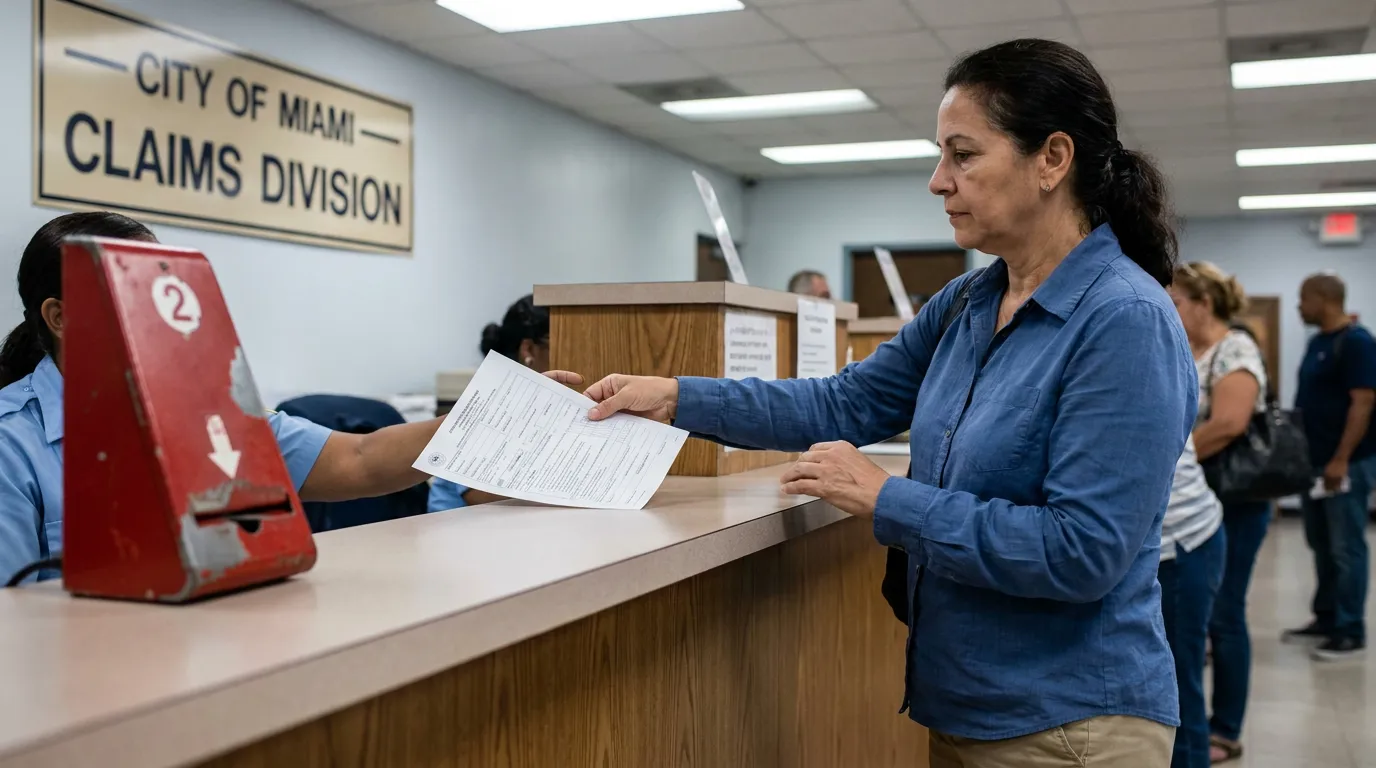
Why Suing a City Is Different From Suing a Private Business
Suing a government entity involves a legal doctrine that does not apply to private property owners. Historically, the government could not be sued at all under sovereign immunity. Florida changed that by statute, but only within defined limits. Section 768.28 is Florida’s statutory waiver of sovereign immunity, allowing municipalities like the City of Miami to be sued in tort only within the limits the statute sets.
This waiver is meaningful but conditional. Florida allows injured parties to sue cities where a private person would be liable, but caps recovery at $200,000 per person and $300,000 per incident absent a legislative claims bill. A claim against the City of Miami is treated differently from a claim against a private business. You can learn more about how these limits work in our discussion of Florida sovereign immunity.
The distinction affects strategy from day one. Because the government enjoys unique protections, the procedural rules are unusually strict. Missing a step can end an otherwise strong premises liability Florida claim.
The Florida 768.28 Notice of Claim Requirement Explained
The written pre-suit notice is the most important procedural step in a city slip and fall case. Under Fla. Stat. § 768.28(6)(a), an action may not be instituted on a claim against the state or one of its agencies or subdivisions unless the claimant presents the claim in writing to the appropriate agency.
This requirement functions as a condition precedent, not an element of your case. The notice requirement is a strict condition precedent to maintaining a lawsuit, meaning a slip-and-fall victim generally cannot sue Miami without first complying. You can review the current statutory text through the official 2025 Florida Statutes section 768.28 published by the state legislature.
There is also a firm timing element. The written notice must generally be presented within 3 years after the claim accrues (a shorter 2-year period applies to wrongful death claims). Courts interpret these timing conditions narrowly, so waiting is rarely wise.
💡 Pro Tip: Preserve evidence such as surveillance footage, maintenance logs, and witness contact information immediately. Government agencies may overwrite footage on short cycles, and early preservation requests can make a difference later.
Where to Send the Notice for a City of Miami Claim
Not every government claim goes to the same place. Claims against a municipality are specifically exempted from the requirement to also notify the Florida Department of Financial Services, so for a suit against the City of Miami, written notice goes to the municipality itself but not to DFS. This distinction commonly trips up people who read the general rule without noticing the exception.
Confirming exactly which agency should receive the notice is a key early step. Because these requirements are technical, many injured people consult a knowledgeable slip and fall attorney Miami to confirm proper delivery.
What Happens After You File the Notice
Filing the notice starts a waiting period before you can sue. The city has an opportunity to investigate and respond. A failure by the city or agency to dispose of the claim within 6 months is deemed a final denial, allowing the claimant to proceed to suit. This provision, found in Fla. Stat. § 768.28(6)(d), prevents an agency from stalling indefinitely.
In many cases, the denial is what opens the courthouse door. Notice to the agency and denial of the claim are conditions precedent to maintaining an action but are not deemed elements of the cause of action, under Fla. Stat. § 768.28(6)(b).
Two Separate Deadlines You Cannot Confuse
Government slip and fall claims involve more than one clock, and mixing them up can be costly. The notice window and the lawsuit filing deadline are distinct. Separate from the notice window, for negligence-based claims accruing on or after March 24, 2023, the lawsuit itself must generally be filed within 2 years of accrual under Fla. Stat. § 95.11(4)(a), as amended by HB 837 (with wrongful death actions governed by the limitations period in Fla. Stat. § 95.11(5)).
The table below summarizes the key timelines:
| Requirement | General Deadline | Statutory Source |
|---|---|---|
| Written notice of claim | Within 3 years of accrual | Fla. Stat. § 768.28(6)(a) |
| Agency response window | 6 months to dispose or deemed denied | Fla. Stat. § 768.28(6)(d) |
| Filing the civil lawsuit | Within 2 years of accrual (for claims accruing on or after March 24, 2023) | Fla. Stat. § 95.11(4)(a) |
These deadlines are not interchangeable. Presenting notice does not extend your time to file suit, and filing suit does not cure a missing notice. Because timing can hinge on when a claim legally accrues, confirming the correct dates early is important.
How Damage Caps Affect the Value of Your Case
Even a successful city slip and fall case is subject to statutory limits on recovery. This is a critical reality for anyone facing surgery, rehabilitation, or lost wages after a fall on government property.
The statute allows judgments above the cap, but payment is another matter. Under Fla. Stat. § 768.28(5), the excess over $200,000 or $300,000 may be paid in part or in whole only by further act of the Legislature. This claim bill process is uncertain and outside the normal court system.
The sovereign immunity doctrine has a long and debated history. Legal commentators continue to examine how far these protections should extend, including in a widely read Florida Bar Journal analysis of who qualifies for immunity.
Practical Steps to Protect a Miami Injury Claim
Taking prompt, organized action can strengthen a notice of claim Florida case. Consider the following steps if you were hurt on city property:
- Seek medical care immediately and keep every record, bill, and diagnosis.
- Photograph the hazard, the surrounding area, and any warning signs or their absence.
- Identify witnesses and collect their contact information before they leave.
- Request preservation of surveillance video and maintenance records in writing.
- Note the exact location and property ownership to identify the correct agency.
These steps support the core elements of a premises liability claim. To recover, an injured person generally must show duty, breach, causation, and damages. Building a strong factual record early helps counter common insurer defenses.
💡 Pro Tip: Send hazard-preservation requests as soon as possible. Once video is lost, reconstructing what happened becomes far more difficult.
Frequently Asked Questions
- Can I sue the City of Miami without filing a notice of claim first?
Is the notice of claim always required before suing a city?
Generally, yes. A lawsuit against a government entity cannot proceed unless the claimant first presents a written claim to the appropriate agency under Fla. Stat. § 768.28(6)(a). Narrow exceptions may exist, so individual facts should be reviewed.
- How long do I have to file the notice?
What is the deadline for the pre-suit notice?
Florida law requires the notice be presented within 3 years after the claim accrues, and the claim must be denied before suit, under Fla. Stat. § 768.28(6)(a). Accrual dates can be fact-specific.
- Do I have to notify the Department of Financial Services for a City of Miami claim?
Does a municipal claim require DFS notice?
For claims against a municipality, the notice must be presented to the agency but is exempt from also notifying the Department of Financial Services.
- How much can I recover from a city in a slip and fall case?
Are there limits on government payouts?
Yes. Under Fla. Stat. § 768.28(5), recovery is capped at $200,000 per person and $300,000 per incident, with any excess payable only through a legislative claim bill.
- What happens if the city ignores my claim?
Can silence from the city help my case?
A failure by the city to make final disposition within 6 months after the claim is filed is deemed a final denial, allowing the claimant to proceed to suit under Fla. Stat. § 768.28(6)(d).
Protecting Your Path to Compensation
In most situations, a Miami slip and fall victim cannot sue a city without first satisfying the florida 768.28 notice of claim requirement. The notice must reach the correct agency within three years of accrual, and the claim must be denied before the lawsuit begins. For negligence-based claims accruing on or after March 24, 2023, the civil action must generally be filed within two years, and any recovery is subject to statutory caps. These rules are strict, and courts apply exceptions narrowly, so acting early gives you the best chance to protect your rights.
If you were injured on city-owned property in South Florida, you do not have to navigate these deadlines alone. Contact Chalik & Chalik Injury Lawyers by calling 954-476-1000, submitting our free consultation request, or visiting our main office page to learn how we can help.


 Who Is Liable for a Slip and Fall at Fort Lauderdale Airport?
Understanding Liability After a Terminal Fall at Fort Lauderdale, Hollywood International Key Takeaways: Liability for a slip and fall at Fort Lauderdale, Hollywood International Airport depends on who controlled the area where you were hurt, the airport authority, a maintenance contractor, an airline, or a retail tenant. Florida allocates fault by percentage, with multiple parties...

Key Takeaways: After a slip and fall in restaurant, critical evidence like surveillance footage and incident reports can disappear quickly. A spoliation letter is a formal demand requiring the restaurant to preserve all evidence related to your fall. Florida law recognizes both sanctions and an independent cause of action for evidence destruction, meaning restaurants that...

Workers get injured due to fall accidents every year. Unfortunately, these slip and fall injuries account for economical loss, pain and suffering, and even death in some cases. Because most of these injuries are generally preventable, workers need to learn how to identify trouble areas at the workplace and report any hazards to their employers....

As Fort Myers personal injury attorneys, we have represented victims of premises liability accidents in Florida for a number of injuries. While head injuries can be some of the most serious injuries that victims of falls may suffer from, joint injuries are often the most common. Shoulder injuries from slip and fall accidents in South...

There are two main types of slip and fall accidents: Elevated falls – These occur when a person falls from one level down onto another. They can be as simple as tripping off a sidewalk into the road, or as complex as falling off scaffolding on a construction site. Same-level falls – These occur when...

In order to protect your rights after a slip and fall accident, you should: First seek immediate medical attention Report the fall to the management of the business establishment Contact the police Take photographs of the accident scene, if possible Obtain witness contact information Write down your experience of the accident A slip and fall...

The cost of your medical bills and the financial value of your pain and suffering are two separate parts of an insurance claim or personal injury lawsuit. If you are injured in a car crash, trip and fall accident, or any other type of accident, you can collect compensation from the person responsible for the...

Legally, you are not required to hire a lawyer for a slip and fall in Florida. However, having an attorney who understands premises liability law, knows how to negotiate with insurance companies, and can represent your interests in court offers a healthy peace of mind—leaving you to focus on recovering from your injuries. If you...