
Understanding Liability After a Terminal Fall at Fort Lauderdale, Hollywood International
Key Takeaways:Liability for a slip and fall at Fort Lauderdale, Hollywood International Airport depends on who controlled the area where you were hurt, the airport authority, a maintenance contractor, an airline, or a retail tenant. Florida allocates fault by percentage, with multiple parties potentially sharing responsibility proportionately. As an invitee, travelers are owed the highest duty of care. Proving a claim requires establishing duty, breach, causation, and damages, with notice of the hazard often the toughest hurdle. Under Florida’s modified comparative negligence rule from HB 837, recovery is reduced by your share of fault and barred entirely if you are more than 50 percent responsible. Claims accruing on or after March 24, 2023 must be filed within two years, and government airport authorities may impose separate pre-suit notice requirements. Prompt documentation and early legal guidance are critical as evidence like surveillance video disappears quickly.
When you slip and fall inside a busy airport terminal, the pressing question is who is legally responsible. In Florida, property owners must maintain reasonably safe conditions, and premises liability holds owners and occupiers responsible for injuries caused by unsafe conditions. At FLL, responsibility can fall on the airport authority, a maintenance contractor, an airline, or a retail tenant, depending on who controlled the area where you were hurt.
If you were injured at a Broward County airport, the team at Chalik & Chalik Injury Lawyers is ready to help. Call us at 954-476-1000 or use our online case review form to discuss your claim.
Who Can Be Held Responsible When You Fall at the Airport
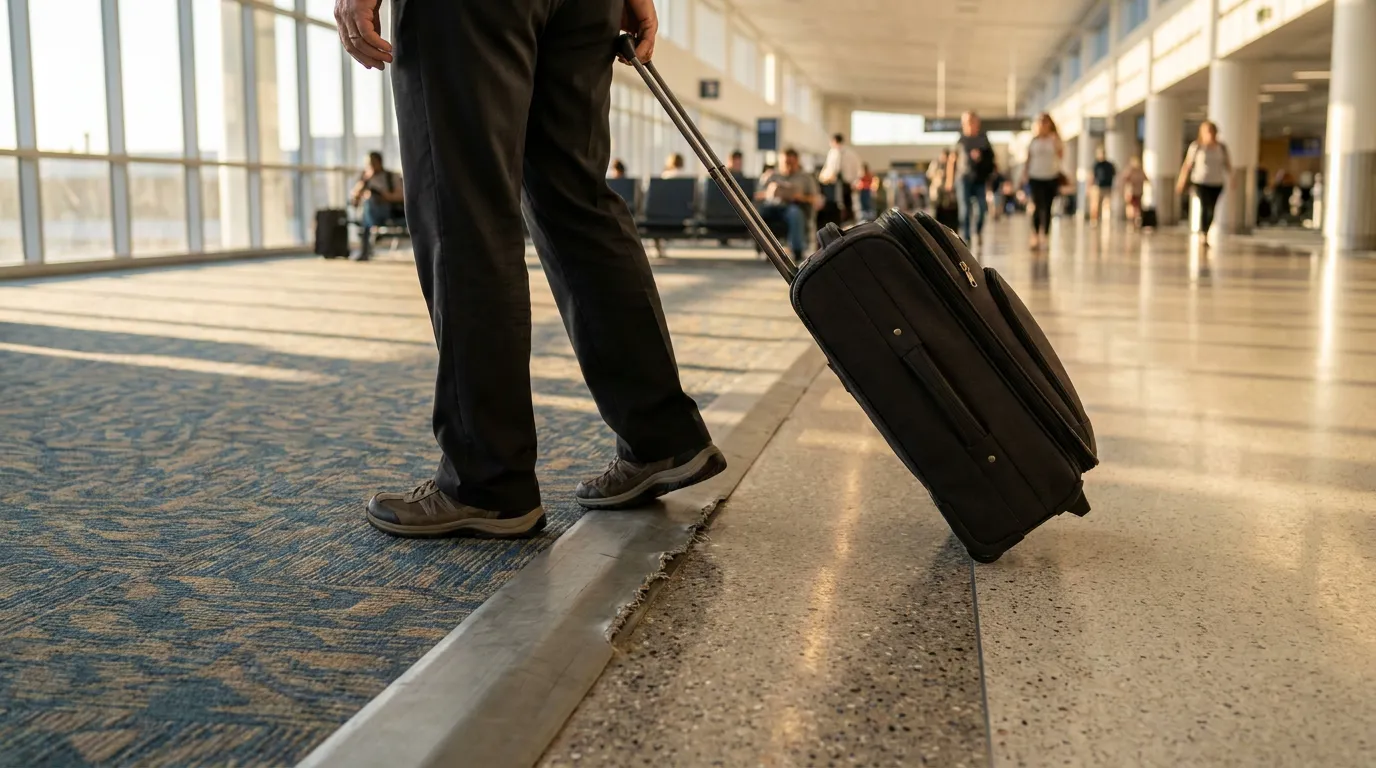
Liability in an airport slip-and-fall is rarely limited to a single party. A large terminal involves many entities controlling different spaces, from ticketing counters to concourses to baggage claim. Florida allocates fault by percentage, so multiple defendants may share responsibility.
Florida allocates liability based on each party’s percentage of fault. Where multiple parties such as an airport authority, a maintenance contractor, or a tenant may be responsible, each is generally liable only for its proportionate share. Identifying every potentially liable party early affects how much compensation is available and from whom.
💡 Pro Tip: Note exactly where you fell, including the concourse, gate area, or store, and photograph nearby signage. The party that controls that specific space is often central to a Ft Lauderdale airport accident claim.
Your Legal Status Determines the Duty You Are Owed
Florida law first asks what your legal status was on the property. Florida classifies plaintiffs as invitee, licensee, or trespasser. This classification matters because the duty owed shifts with each category.
Most travelers are invitees, individuals invited for a business purpose who are owed the highest duty, including regular inspection, repair, and warning of hazards. That elevated standard is significant for airport premises liability in Florida.
Common Terminal Hazards That Lead to Injury
Airport slip-and-fall injuries often trace back to preventable maintenance failures. Common examples include spills and debris, faulty equipment such as malfunctioning elevators, escalators, or automatic doors, and inadequate lighting.
These conditions commonly occur in an FLL terminal:
- Wet or freshly mopped tile floors near restrooms, restaurants, and entrances
- Spilled liquids, food debris, or loose carpeting in concourses
- Malfunctioning escalators, moving walkways, or automatic doors
- Poor lighting in parking structures, stairwells, or jet bridges
You can learn more about how courts treat these conditions through resources on inadequate property maintenance. Whether these facts support a claim depends on the evidence and applicable Florida standards.
Proving Negligence in a Slip and Fall FLL Terminal Case
Winning an airport injury claim in Florida requires proving four distinct elements. These elements must be supported by evidence, not assumption.
Duty and Breach
The claim begins with establishing that the responsible party owed you a duty and failed to meet it. To recover, an injured patron must prove duty, breach, causation, and damages. For an invitee, breach generally means the airport or tenant failed to inspect, repair, or warn as a reasonably careful operator should have.
The Notice Requirement
One of the toughest hurdles is proving the property owner knew or should have known about the hazard. Notice, whether actual or constructive, is central to proving breach. In Florida, slip-and-fall claims involving a transitory foreign substance are governed by Fla. Stat. § 768.0755, which requires proof that the business establishment had actual or constructive knowledge of the dangerous condition. Constructive knowledge may be shown by evidence that the condition existed long enough to be discovered, or occurred with such regularity that it was foreseeable. Florida premises liability also turns on foreseeability, though Florida courts have diverged on interpretation, as discussed in analysis of a notable rift in premises liability law published by the Florida Bar.
Causation and Damages
Finally, you must connect the breach to your injury and document your losses. Causation links the unsafe condition to the harm, while damages cover medical bills, lost income, and related losses. Expert testimony and preserved evidence often make the difference.
💡 Pro Tip: Constructive notice can sometimes be shown by evidence that a hazard existed long enough that staff should have discovered it, such as dried liquid or track marks through a spill.
How Florida’s Comparative Negligence Rule Affects Your Recovery
Even if the airport was negligent, your own conduct can reduce what you recover. Florida follows a modified comparative negligence system effective March 24, 2023 through HB 837.
Under Fla. Stat. § 768.81(6), any party found greater than 50 percent at fault for his or her own harm may not recover damages, subject to a medical negligence exception. Below that bar, your award is adjusted rather than eliminated. Under Fla. Stat. § 768.81(2), contributory fault diminishes proportionately the amount awarded as damages but does not bar recovery, subject to subsection (6).
Defendants frequently lean on these rules. Common defenses include open and obvious danger, lack of notice, and comparative fault. You can review the full statutory framework governing apportionment of damages under Chapter 768.
💡 Pro Tip: Wearing appropriate footwear and staying attentive does not waive your rights, but expect scrutiny of your conduct. Preserving witness statements early can help counter comparative-fault arguments.
Deadlines You Cannot Afford to Miss
Florida sets a firm deadline for filing a personal injury lawsuit, and missing it can end your case. The controlling statute is Fla. Stat. § 95.11. The 2023 tort reform shortened the window for negligence claims.
| Claim Accrual Date | Limitations Period |
|---|---|
| Before March 24, 2023 | Four years |
| On or after March 24, 2023 | Two years |
For current Fort Lauderdale slip-and-fall claims accruing on or after March 24, 2023, the deadline is now two years. Limited exceptions such as tolling may apply in narrow situations, but Florida courts interpret those exceptions narrowly. Because FLL is operated by Broward County, a claim against the airport authority may fall under Florida’s sovereign immunity statute, Fla. Stat. § 768.28. That law generally requires written pre-suit notice to the responsible agency and the Florida Department of Financial Services within three years of the incident, imposes a 180-day investigation period before suit may be filed, and caps tort recovery at $200,000 per person and $300,000 per incident. These government-claim requirements are distinct from, and in addition to, the two-year civil statute of limitations. Because timing rules are strict, consult a lawyer promptly.
Working With an Airport Slip and Fall Attorney Ft. Lauderdale Travelers Trust
Airport cases involve overlapping parties, government entities, and short deadlines, making early legal guidance valuable. A knowledgeable airport slip and fall attorney Ft. Lauderdale residents rely on can help identify who controlled the hazardous area, gather security footage before it is overwritten, and evaluate comparative-fault exposure.
An experienced Fort Lauderdale airport slip and fall attorney can coordinate incident reports, medical records, and witness accounts into a coherent claim. Our airport injury attorney Fort Lauderdale resource explains how these cases proceed. Every case turns on its own facts.
💡 Pro Tip: Request that the airport preserve surveillance video in writing as soon as possible. Footage is frequently recorded over within days.
Frequently Asked Questions
-
Who is liable if I fall in an airport restaurant or shop?
Liability depends on who controlled that space. A retail tenant or food vendor may share fault with the airport authority, with each party responsible only for its percentage of fault.
-
What if I was partly at fault for my fall?
Under Fla. Stat. § 768.81(2), your damages are reduced by your share of fault. However, under § 768.81(6), a plaintiff found more than 50 percent at fault may be barred from recovering.
-
How long do I have to file a slip and fall claim at FLL?
For claims accruing on or after March 24, 2023, Fla. Stat. § 95.11 provides a two-year window. If the claim is against the county-operated airport authority, separate sovereign-immunity notice rules under Fla. Stat. § 768.28 also apply.
-
What evidence helps prove airport accident liability Ft Lauderdale claims?
Incident reports, security video, photographs, witness contact information, and medical records are key. Evidence of how long a hazard existed can help establish the notice requirement.
-
Do I have to prove the airport knew about the hazard?
Generally, yes. For a slip and fall on a transitory foreign substance, Fla. Stat. § 768.0755 requires you to show actual or constructive notice, meaning the operator knew or reasonably should have known about the dangerous condition.
Protecting Your Rights After a Terminal Injury
Determining who is liable for a slip and fall at Fort Lauderdale airport requires examining your legal status, identifying every party that controlled the area, proving the four elements of negligence, and accounting for Florida’s modified comparative negligence rule and shortened filing deadline. Because these cases are fact-intensive and involve multiple potential defendants, outcomes depend heavily on evidence and how quickly it is preserved.
If you or a loved one was hurt in an FLL terminal, the attorneys at Chalik & Chalik Injury Lawyers are prepared to review your situation. Call 954-476-1000 today or complete our confidential contact form to protect your claim.


What Is Florida’s Premises Liability Law for Slip and Falls? Florida’s premises liability law requires injured victims who slip on transitory foreign substances to prove the property owner had actual or constructive knowledge of the dangerous condition. This legal standard, codified in Florida Statute 768.0755, governs slip and fall claims throughout the state, including Ft...

Understanding Your Rights After a Slip and Fall in Restaurant Dining Areas Key Takeaways: If you slip and fall in a Ft Lauderdale restaurant, Florida law may entitle you to compensation, but you must prove the business had actual or constructive knowledge of the hazard under §768.0755. You have two years from the injury date...

When a Resort Vacation Turns Into a Slip and Fall Nightmare A relaxing getaway to a Ft Lauderdale resort can take a painful turn if you slip, trip, or fall due to a hazardous condition on the property. If you’re dealing with medical bills, lost wages, or lengthy recovery after a resort fall, you may...
 What Should You Do After a Slip and Fall in Ft Lauderdale?
What Should You Do After a Slip and Fall in Ft Lauderdale? A slip and fall accident can happen in seconds, but the steps you take immediately afterward can determine whether you receive fair compensation for your injuries. Whether you’ve fallen at a grocery store, restaurant, hotel, or shopping mall in Ft Lauderdale, knowing what...

You can suffer severe injuries from a slip and fall in a Publix Supermarket. A broken hip or fractured skull may hospitalize you for weeks or months, straining you both physically and financially. If the insurance company is not negotiating in good faith for a fair settlement, seeking legal action against the grocery store may...

If you slip and fall at a La Quinta Inn, you should get the medical care you need and then take the necessary steps to protect your rights. Proving that a La Quinta Inn employee or owner’s negligence caused your accident is essential to building a persuasive compensation claim. Suffering injuries on someone else’s property...

If you slip and fall at a dollar store, these are the following steps you should take to ensure your health and possibly support your personal injury or premises liability claim: You should check for injuries and get immediate medical attention to address them. You should collect evidence while still inside the store by taking...

A slip and fall accident can happen when a property owner fails to maintain safe conditions. If you were hurt in a fall, you must prove that someone else’s negligence caused your injuries. Proving fault is essential to recovering compensation for medical expenses, lost wages, and other damages. In a slip and fall case, the...