
Understanding Your Legal Duties After a Fort Lauderdale Airport Injury
Key Takeaways:If you are injured at Fort Lauderdale-Hollywood International Airport, the party receiving your pre-suit notice depends on who operates the property and who was negligent. Because Broward County operates the airport, claims against this public entity are governed by Florida’s sovereign immunity statute, Section 768.28, which requires written notice to the appropriate county agency. Counties are exempt from the Department of Financial Services notice that most state claims require, though private parties like airlines, vendors, or contractors may be subject to ordinary personal injury rules. Strict deadlines apply, generally three years for tort injuries and two years for wrongful death. After notice is presented, the agency’s failure to respond within six months (or 90 days for certain claims) is deemed a denial, allowing suit to proceed, subject to damage caps of $200,000 per person and $300,000 per incident. Getting the correct recipient and timing right is critical, as a missed or defective notice can end an otherwise strong claim.
If you were hurt at Fort Lauderdale-Hollywood International Airport, the party that must receive your pre-suit notice depends on who operates the property and who was negligent. Because the airport is run by Broward County, a claim against that government body triggers special notice rules. Under Florida law, written notice must go to the appropriate county agency before any lawsuit can proceed. Getting this step right matters, because a missed or defective notice can end an otherwise strong airport negligence claim.
If you are unsure who must be notified or how much time you have, the team at Chalik & Chalik Injury Lawyers can help you protect your rights. Call us at 954-476-1000 or reach out through our online case review page to discuss your situation. Acting quickly helps preserve evidence and keeps your options open.
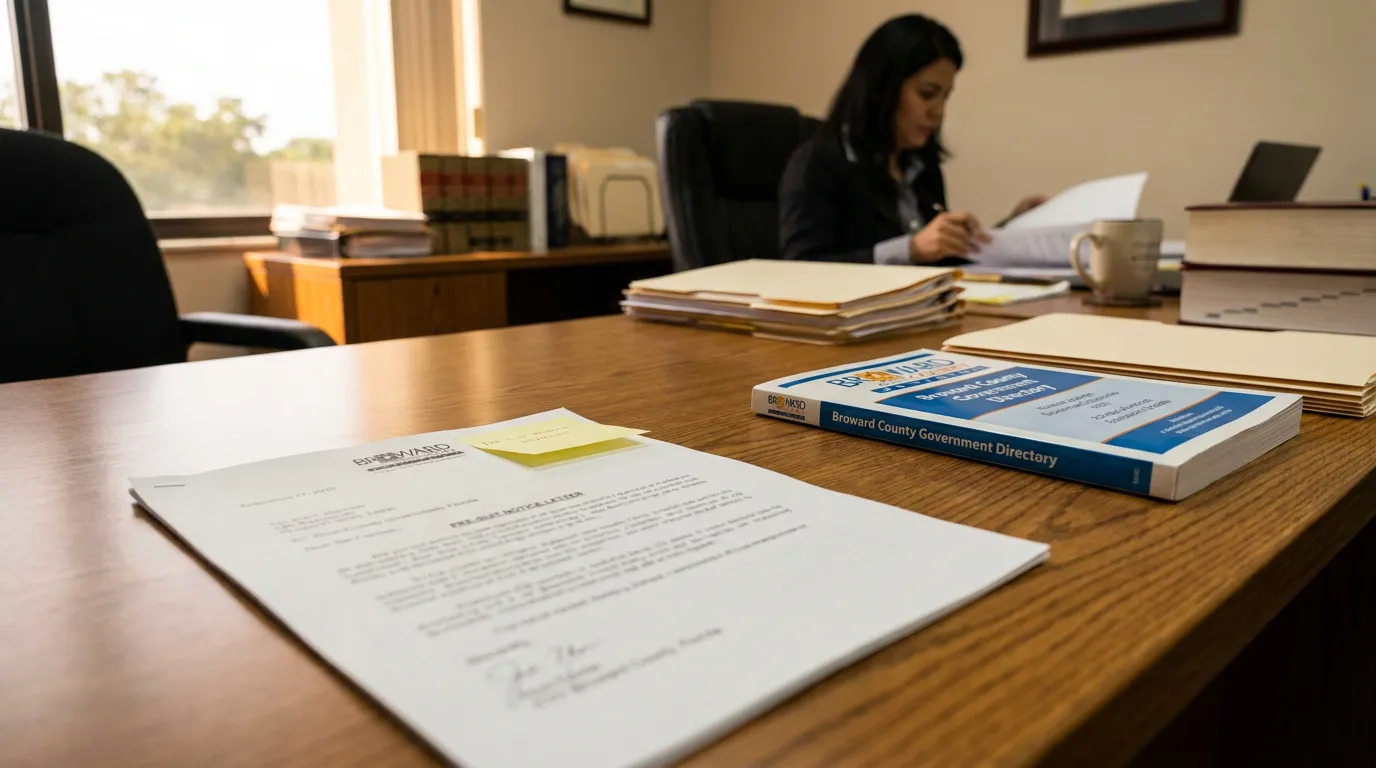
Why Sovereign Immunity Shapes a Ft Lauderdale Airport Accident
Sovereign immunity is the legal doctrine that historically shielded government entities from lawsuits, and it directly controls how you pursue an airport injury against a public operator. Florida has waived part of that protection by statute, but only if claimants follow strict procedures. Section 768.28 preserves sovereign immunity while waiving it for torts caused by the negligent or wrongful act or omission of any employee of the agency or subdivision while acting within the scope of employment. You can review the full text of Florida’s sovereign immunity statute for the precise language.
This waiver is the foundation for every pre-suit notice obligation against a public airport operator. Florida Statute 768.28(2) defines "state agencies or subdivisions" to include counties and municipalities, as well as corporations primarily acting as instrumentalities or agencies of the state, counties, or municipalities. Because Broward County operates the airport, it falls squarely under these sovereign immunity notice rules.
Who Must Receive Florida Statute 768.28 Pre-Suit Notice
The florida statute 768.28 pre-suit notice must reach the appropriate government agency before a lawsuit can be filed. Under Fla. Stat. § 768.28(6)(a), an action may not be instituted on a claim against the state or one of its agencies or subdivisions unless the claimant presents the claim in writing to the appropriate agency, and also, except as to any claim against a municipality, county, or the Florida Space Authority, presents such claim to the Department of Financial Services. That carve-out is central to airport cases in Broward County.
Notice to the Appropriate Government Agency
Every claim against a public entity starts with written notice to the agency responsible for the alleged negligence. For a fall in the terminal, a shuttle collision, or a baggage-claim injury on county-operated property, that generally means the county body that manages the airport. This written presentation is a statutory condition that courts interpret strictly.
The Department of Financial Services Exception for Counties
Claims against a county are exempt from the Department of Financial Services notice that most state claims require. Fla. Stat. 768.28(6)(a) exempts claims against a municipality, county, or the Florida Space Authority from the Department of Financial Services notice requirement. In practice, this means a Fort Lauderdale airport accident tied to Broward County generally requires notice directed to the appropriate county agency rather than the state.
The correct recipient can depend on the facts. If a private airline, retail vendor, food-court operator, or on-site contractor caused the harm, that party may be a private defendant subject to ordinary personal injury rules rather than sovereign immunity. Sorting out which entities are public and which are private is one of the first tasks in any airport negligence claim.
💡 Pro Tip: Save every incident report number, the names of responding personnel, and any airport-issued paperwork. These details help identify the correct agency and confirm that notice was properly delivered.
Deadlines That Control Your 768.28 Notice of Claim
A 768.28 notice of claim is subject to firm deadlines, and both notice and denial function as conditions precedent to filing suit. Under Fla. Stat. § 768.28(6)(a)-(b), the claim must be presented within 3 years after such claim accrues, and notice and denial are conditions precedent to maintaining an action. Missing that window can bar recovery regardless of injury severity.
These government administrative deadlines are separate from Florida’s civil statute of limitations for negligence. The 2024 Florida Statutes 95.11 govern limitations other than for the recovery of real property. You can read Florida’s civil limitations statute to see how filing deadlines are structured for personal injury actions.
Section 95.11 contains a narrow discovery-based provision for medical malpractice actions, but courts apply it cautiously. In medical malpractice actions specifically, the period may be extended forward 2 years from the time that the injury is discovered or should have been discovered with the exercise of due diligence, but in no event to exceed 7 years from the date the incident occurred, when fraud, concealment, or intentional misrepresentation of fact prevented the discovery of the injury. This provision applies to medical malpractice claims and does not extend to general personal injury or tort claims. Courts interpret such exceptions narrowly.
Wrongful Death and Shorter Windows
Wrongful death claims against a government entity face a shorter notice window than ordinary injury claims. Under Fla. Stat. § 768.28(6)(a)(2), if such action is for wrongful death, the claimant must present the claim in writing to the Department of Financial Services within 2 years after the claim accrues. Because the timelines differ by claim type, confirming the applicable deadline early is critical.
| Claim Type | Pre-Suit Notice Deadline | Governing Provision |
|---|---|---|
| General tort injury | Generally within 3 years of accrual | § 768.28(6)(a) |
| Wrongful death | Within 2 years of accrual | § 768.28(6)(a)(2) |
What Happens After You Send Your Government Notice
After you present notice, the agency has a defined period to respond, and its silence can eventually be treated as a denial. Under Fla. Stat. § 768.28(6)(d), failure to make final disposition of a claim within 6 months after it is filed shall be deemed a final denial, with a 90-day period for medical malpractice and wrongful death actions. Only after denial, whether express or deemed, can the lawsuit proceed.
Preserving evidence during this waiting period is one of the most valuable things you can do. Airport surveillance footage may be overwritten, witnesses move on, and hazards get repaired. Gathering proof early supports the core elements of any negligence case. For a practical walkthrough of early actions, see our guide on what to do after an airport injury.
Helpful documentation often includes:
- Incident reports and any airport-issued claim numbers
- Photographs of the hazard, your injuries, and the surrounding area
- Names and contact details of witnesses and responding staff
- Medical records connecting the injury to the airport incident
Damage Caps and Practical Challenges in Government Injury Claims
Even a successful claim against a county is subject to statutory limits on the amount recoverable. This is a key difference from a claim against a purely private defendant. Under Fla. Stat. § 768.28(5)(a), liability is limited so that no claim exceeds the sum of $200,000 per person or $300,000 per incident, with any excess payable only by further act of the Legislature. Amounts above those caps generally require a separate legislative claims bill, which is a difficult and uncertain process.
These caps and procedures make government entity injury cases uniquely demanding. Determining whether the airport operator, an airline, or a contractor bears responsibility can change every deadline and recipient in your case. Because outcomes depend heavily on the specific facts, working with an airport accident lawyer Florida residents trust can help you avoid procedural missteps.
Frequently Asked Questions
-
Do I have to notify the Department of Financial Services for a Broward County airport claim?
Generally, no. Fla. Stat. 768.28(6)(a) exempts claims against a municipality, county, or the Florida Space Authority from the Department of Financial Services notice requirement. Because the airport is county-operated, notice is typically directed to the appropriate county agency.
-
How long do I have to file a pre-suit notice?
The timeline depends on the type of claim. Under § 768.28(6)(a)-(b), the claim must generally be presented within 3 years after it accrues. Wrongful death claims have a shorter two-year window.
-
Is the notice deadline the same as the statute of limitations?
No, these are separate requirements. The government notice rules under § 768.28 run alongside the civil filing deadlines in § 95.11. Both must be tracked carefully.
-
Can the agency’s silence count as a denial?
Yes. Fla. Stat. § 768.28(6)(d) provides that failure to make final disposition within 6 months is deemed a final denial, with a shorter 90-day period for medical malpractice and wrongful death actions.
-
Is my recovery limited if I sue a government entity?
Often, yes. Fla. Stat. § 768.28(5)(a) caps liability at $200,000 per person and $300,000 per incident, with any excess payable only by further act of the Legislature.
Protecting Your Claim After a Fort Lauderdale Airport Accident
Knowing who must receive pre-suit notice, and when, is the difference between preserving your claim and losing it on a technicality. For a county-operated airport, the written claim generally goes to the appropriate county agency, with the Department of Financial Services exception applying to counties. Firm deadlines, conditions precedent, and statutory damage caps all shape potential recovery.
If you or a loved one was hurt at the airport, the attorneys at Chalik & Chalik Injury Lawyers are ready to review your options. Call 954-476-1000 today or send us a message through our confidential contact form to get started. The sooner you act, the more we can do to safeguard your evidence and your rights.



 Young boy suffers head injury at a Florida sports park
According to the Brevard County Fire Rescue, on March 14, a child was airlifted to a trauma center after he suffered a severe head injury at the Space Coast Field of Dreams Sports Park in West Melbourne, Florida. No information is available about how the injury occurred or the condition of the child. Space Coast...
 South Florida Couple Files Lawsuit Against Princess Cruises Over Coronavirus Pandemic
A South Florida couple who were aboard Princess Cruises’ Grand Princess have filed a lawsuit against the cruise line based on allegations of negligence. The coronavirus (COVID-19) pandemic struck multiple cruise ships in a major way, and Princess Cruises had multiple ships where passengers and crew members fell ill with the virus. The Grand Princess...
 The Affluenza Defense: A Dangerous Precedent in a Fatal DUI Case
A recent Texas DUI manslaughter verdict has victim advocates concerned that wealth may increasingly be used as a legal defense for negligence. The verdict arose from the trial of Ethan Couch, a 16-year-old boy who killed four people and injured two in a drunk driving crash on June 15, 2013. Couch’s defense attorney successfully argued...
 Can Journaling Help a Personal Injury Case in Plantation?
Why Your Words Can Become Powerful Evidence in a Plantation Injury Claim Key Takeaways: Yes, journaling can strengthen a personal injury case in Plantation, Florida by creating a contemporaneous record of pain levels, treatments, missed workdays, and emotional struggles that memory and medical charts often miss. A consistent recovery journal supports proving negligence, particularly causation...
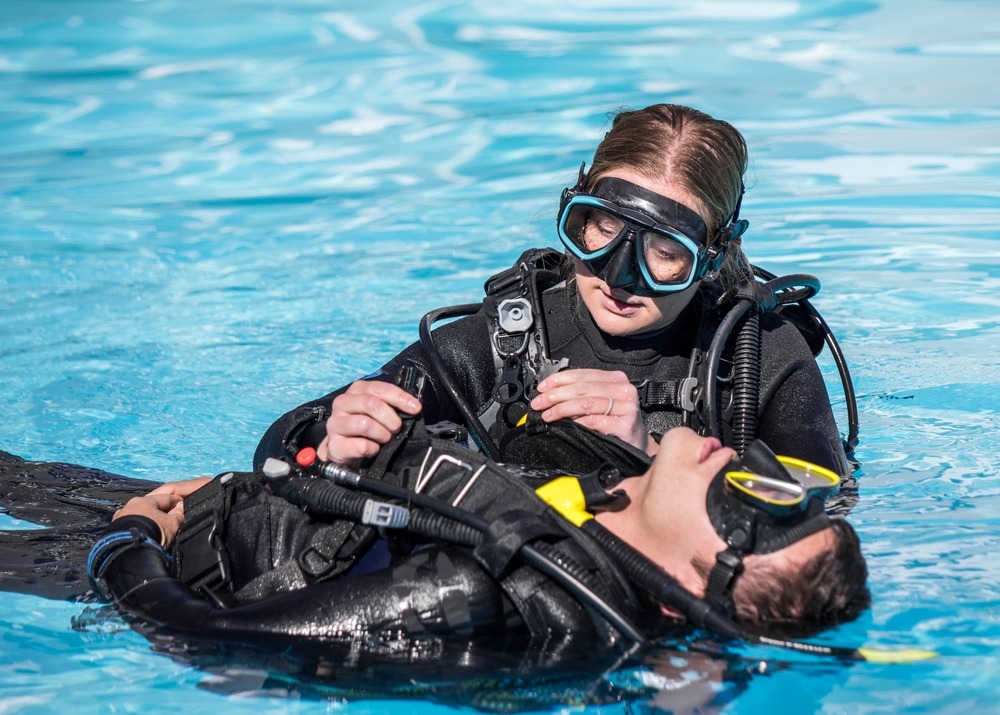 Can I Sue MSC Cruises if I Was Injured While Scuba Diving?
You can sue MSC Cruises if you were injured while scuba diving, but only if your case meets the following four criteria: MSC Cruises was responsible for your safety in this particular situation. MSC Cruises behaved negligently and put you in danger. Thanks to MSC Cruises’ negligence, you were involved in a scuba diving accident....
 How to File a Dog Bite Report in Plantation
Being bitten or attacked by a dog can be frightening, stressful, and may leave you uncertain about what to do. Once your injuries allow, you should file a dog bite report in Plantation, Florida. Your report can be made by phone to Broward County Animal Care officials. This report can help you learn about the...
 What to Do If You’re Injured at a Concert or Festival?
After suffering an injury at a concert or festival, you should visit a doctor immediately. Once you are safe, a lawyer can help you act against the liable party. When a Fort Lauderdale personal injury lawyer represents you, they guide you through every aspect of your case. They will bring a pool of resources and...
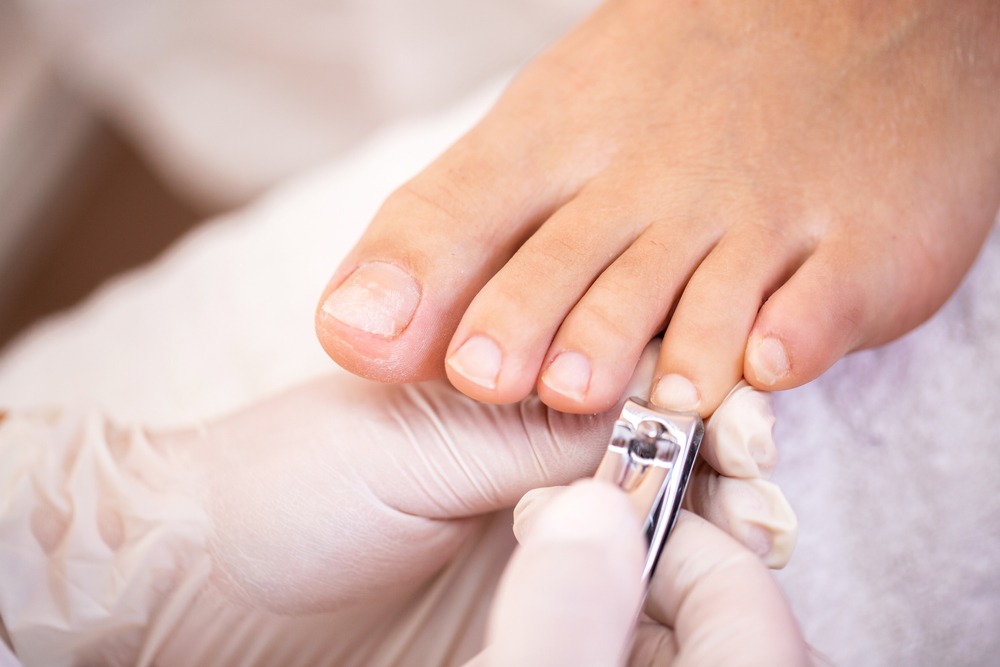 How to Report a Nail Salon in Florida
At Chalik & Chalik Injury Lawyers, our legal team advocates for people who wrongfully contracted infections or suffered an injury after getting nail services at a salon. Recently, our team won a $150,000 settlement for a nail salon victim who developed severe rashes and other illnesses because of poor hygiene practices at a Fort Myers...