
How Shared Fault Can Change the Value of Your Miami Car Accident Claim
Key Takeaways:Florida’s 51 percent comparative negligence bar, found in Fla. Stat. § 768.81(6), generally prevents an injured person from recovering damages if they are found more than 50 percent at fault. At exactly 50 percent or less, recovery may still be allowed, but the award is generally reduced in proportion to the claimant’s share of blame under § 768.81(2). This modified system replaced Florida’s former pure comparative negligence rule through a 2023 amendment that does not apply to causes of action accruing before March 24, 2023. The subsection excludes medical negligence claims under chapter 766, which follow a separate framework. Because a single percentage point can eliminate a claim entirely, insurers may have strong incentives to overstate a claimant’s role through recorded statements, crash report notations, and informal fault assignments. Evidence such as surveillance video, event data recorder downloads, and independent witnesses may shift that percentage, and generally only a court or jury makes the legally operative determination.
Florida’s 51 percent comparative negligence bar prevents an injured person from recovering damages if a jury or court finds them more than 50 percent at fault. If you are 50 percent or less at fault, you may still recover, but your award is generally reduced by your share of blame. For Miami crash victims, this single figure can decide whether a claim is worth pursuing, which is why insurers often contest fault numbers.
If an adjuster has already suggested the wreck was partly your fault, it may be worth speaking with a legal team before you give a recorded statement.Chalik & Chalik Injury Lawyers handles motor vehicle injury claims throughout South Florida and can explain how the fault rules may apply to your situation. Call 954-476-1000 or contact us now to discuss what happened.
What the 51 Percent Comparative Negligence Bar Actually Says
The rule is codified, not merely custom. Fla. Stat. § 768.81(6) provides that any party found greater than 50 percent at fault for his or her own harm may not recover damages. The threshold is exact: 50 percent may still permit recovery, while more than 50 percent generally ends the claim.
This subsection carries an express carve-out. It does not apply to personal injury or wrongful death actions arising from medical negligence under chapter 766. The 51 percent bar generally governs ordinary negligence claims such as car crashes and premises liability, while medical malpractice follows a different framework.
Definitions matter here. Section 768.81(1) defines a "negligence action" to include civil damages claims based on negligence, covering personal injury, wrongful death, and property damage. That broad definition is why the statute is generally the primary authority for fault disputes from a Miami collision. Its comparative fault provisions generally do not apply to intentional torts.
Why 2023 Changed Florida Car Accident Fault Law
Before 2023, Florida followed a pure comparative negligence system, under which a claimant found 80 percent at fault could still potentially recover 20 percent of damages. The Legislature changed course through s. 9, ch. 2023-15, amending § 768.81 to install the modified system now in force.
Timing can control which version applies to your case. The 2023 act does not apply to causes of action accruing before its March 24, 2023 effective date. Claims accruing earlier may still fall under the prior pure comparative framework, though accrual questions can be fact-dependent and disputed. You can review the full text of Florida’s comparative fault statute on the Legislature’s website.
How Damages Are Reduced Below the Threshold
Falling under the bar does not mean full recovery. Section 768.81(2) provides that damages are reduced in proportion to the claimant’s percentage of fault. A claimant found 30 percent responsible for a crash on the Palmetto would generally see a verdict reduced by that same amount.
| Claimant’s Assigned Fault | General Effect Under § 768.81 |
|---|---|
| 0% | No reduction generally applied |
| 25% | Award generally reduced by 25% |
| 50% | Award generally reduced by half; recovery generally still permitted |
| 51% or more | Recovery generally barred under § 768.81(6) |
Actual outcomes depend on the evidence, the jury’s findings, and available insurance coverage.
Apportionment in Multi-Vehicle Miami Crashes
Fault is rarely a two-way split on South Florida highways. Fla. Stat. § 768.81(3) directs courts to enter judgment against each liable party based on that party’s percentage of fault as found by the trier of fact. In a chain-reaction collision on I-95 or the Dolphin Expressway, several drivers may each carry a slice of responsibility.
The Legislature has explained the policy behind this approach. In connection with 2011 amendments, it indicated an intent to overrule prior case law it viewed as failing to apportion fault consistent with Florida’s comparative fault system under § 768.81. The goal is allocation according to each party’s actual share rather than an all-or-nothing outcome, though results often turn on which parties are named and what evidence supports each allocation.
When Another Statute May Control Instead
Specific statutes can displace the general rule in narrow situations. Some narrowly drawn Florida statutes include their own conflict provisions stating they control over § 768.81. Unique liability arrangements involving certain vehicle-related claims may therefore follow a different path.
These scenarios are uncommon in a typical rear-end or intersection crash and tend to matter most with unusual coverage or ownership structures. Courts generally read such carve-outs narrowly.
How Insurers Use Fault Percentage in Florida Claims
Adjusters often understand the math better than most claimants do. Because a finding above 50 percent may eliminate recovery entirely, an insurer may have strong incentive to build a record suggesting you were the primary cause, often starting within days of the collision.
Common tactics include:
- Requesting a recorded statement before treatment is complete
- Framing questions to suggest speed, distraction, or delayed braking
- Treating an ambiguous crash report notation as a fault determination
- Arguing a gap in treatment shows the injuries came from elsewhere
- Assigning a percentage informally to justify a low offer
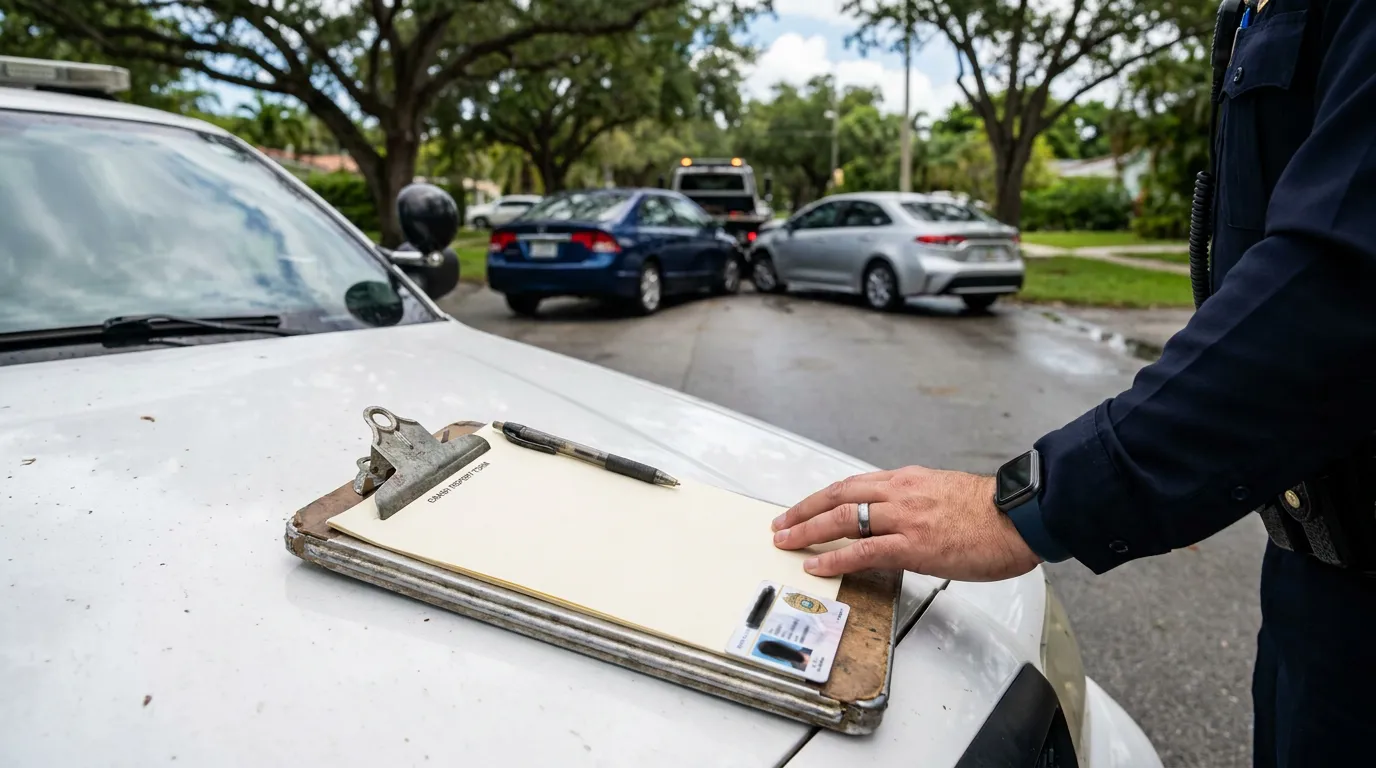
A police report is evidence, not a verdict. Officers document observations under time pressure and may lack access to video, black box data, or independent witnesses. Florida law also limits use of certain crash report information in civil trials, and a court or jury generally makes the actual fault determination, which can differ substantially from an initial narrative.
💡 Pro Tip: Photograph the final resting positions of vehicles, skid marks, and traffic control devices before anything is moved, if safe. Physical evidence can carry more weight than competing recollections months later.
Evidence That Can Shift Your Fault Percentage
Reducing your assigned share is frequently among the highest-value work in a shared fault claim. Moving a claimant from 55 percent to 45 percent may be the difference between no recovery and a partial one. Below the bar, each percentage point can translate directly into dollars.
Several categories of proof tend to matter most: nearby business surveillance footage, traffic camera video, event data recorder downloads, cell phone records, and independent witness accounts can each reframe how a collision occurred. Because Miami businesses often overwrite video within days, prompt preservation requests can be significant, though a business isn’t always obligated to retain footage absent a legal duty. A Miami car accident lawyer can send those requests and coordinate reconstruction where warranted.
💡 Pro Tip: Avoid posting about the crash or your recovery on social media. Defense teams routinely review public profiles and may use ordinary posts to argue inconsistencies.
Comparative Fault Beyond the Roadway
The same statutory framework may reach other injury claims, since § 768.81 applies broadly to negligence actions. Our discussion of how comparative negligence affects slip and fall claims covers that overlap in more detail.
Florida is not alone in using this structure. A 50-state negligence law survey categorizes jurisdictions as pure comparative, modified comparative with a 50 or 51 percent bar, or contributory negligence, placing Florida in the modified comparative group.
Practical Steps After a Crash Where Fault Is Disputed
What you do in the first weeks may influence the fault percentage later assigned to you. Seek medical evaluation promptly, follow your treatment plan, and keep records of every appointment and expense. Consistent documentation can make it harder for an insurer to attribute your injuries elsewhere, and Florida’s no-fault law generally requires initial treatment within 14 days for PIP benefits.
Be measured in what you say. You may need to cooperate with your own insurer under your policy, but that isn’t the same as giving an open-ended recorded statement to the other driver’s carrier. Courts may consider your own statements when weighing fault, so accuracy matters more than speed.
Deadlines are separate from fault questions and should be tracked independently. Florida’s filing deadlines for negligence claims were shortened in 2023: a two-year period generally applies to claims accruing on or after March 24, 2023, and a four-year period generally applies to earlier claims. Exceptions like tolling are generally interpreted narrowly, and claims against government entities operate under separate notice requirements. Because these deadlines are often unforgiving, confirming them early is advisable.
Frequently Asked Questions
1. What happens if I am found exactly 50 percent at fault?
Recovery may generally still be available at exactly 50 percent. § 768.81(6) bars recovery only for a party found greater than 50 percent at fault. Your damages would then generally be reduced by half under § 768.81(2), subject to coverage and case-specific findings.
2. Does the 51 percent bar apply to medical malpractice claims?
No, the subsection expressly excludes them. § 768.81(6) does not apply to personal injury or wrongful death actions arising from medical negligence under chapter 766. Those claims proceed under a different framework.
3. Who decides my fault percentage in a Miami crash case?
The trier of fact generally makes that determination. Under § 768.81(3), judgment is entered based on percentages of fault found by the trier of fact, typically a jury at trial. Most claims resolve beforehand, with parties negotiating around likely jury percentages.
4. My crash happened before March 2023. Which rule applies?
Accrual date generally controls. The 2023 amendment does not apply to causes of action accruing before March 24, 2023, so earlier claims may fall under Florida’s former pure comparative system. Because accrual can be contested, this should be reviewed against your specific facts.
5. Can the insurer simply decide I was more than half at fault?
An insurer’s opinion generally carries no binding legal weight. A carrier may assign a percentage to justify a denial or reduced offer, but generally only a court or jury makes a legally operative determination. Disputed assessments are frequently revised as more evidence develops.
The Bottom Line on Florida’s Fault Threshold for Miami Drivers
Florida’s modified comparative negligence system draws a line at 50 percent. Stay at or below it, and your damages are generally reduced proportionally under § 768.81(2). Cross it, and § 768.81(6) generally eliminates recovery altogether. That structure may give insurers reason to overstate your role in a collision and gives injured people reason to document the crash carefully, protect available evidence, and resist accepting an informal fault percentage as final. Outcomes always depend on the specific facts, applicable coverage, and how a court or jury weighs the evidence.
If liability is being questioned in your case, a conversation about your options costs you nothing.Chalik & Chalik Injury Lawyers represents injured drivers, passengers, pedestrians, and cyclists across Miami-Dade and Broward. Reach the firm at 954-476-1000 or request a free case review to have your crash evaluated.
Disclaimer: This content is for informational purposes only and is not legal advice. Every case is unique, and results may vary. Consult an attorney about your specific circumstances.


Florida has a history of significant numbers of traffic accidents each year. Florida had the third highest number of traffic fatalities in the nation in 2012, second only to Texas and California, according to the U.S. Census Bureau. A new list published by TIME shows that Florida is, unfortunately, living up to its reputation. Of...

Car accidents occur every day in South Florida. Some are fender benders and lead to nothing more than scratches, while others result in devastating injuries that completely change the lives of the victims. While many accidents involve two or more cars, some involve only one or a variety of other vehicles present on the road....

A broken or fractured rib is a very painful medical condition. When trauma to the chest occurs, a broken or fractured rib is a common result. Car accidents are one of the leading causes of trauma to the chest, and therefore one of the leading causes of broken ribs. If you need help recovering compensation...

No one expects to be injured in a Florida car accident. However, you can always prepare for this unlikely instance beforehand and protect your legal rights afterward. One of the most difficult things victims of Florida car wrecks can face is being injured in an accident with a negligent driver who does not have insurance....

According to the National Highway Traffic Safety Administration (NHTSA), the most common cause of rear-end collisions is distracted driving. The second most common cause is following another vehicle too closely. If you were involved in a rear-end collision, you may wonder who is at fault. In most rear-end crashes, the driver in the rear vehicle...

The injuries one may suffer in a car accident varies based on many different factors, including who was involved and the type of collision that occurred. According to the National Center for Biotechnology Information (NCBI)-distributed book Motor Vehicle Collisions (MVCs) by Tammy J. Toney-Butler and Matthew Varacallo, some common accidents with commonly reported injuries include:...

An Uber passenger may be within their legal rights to sue an Uber driver in the event of an accident. Although initial compensation would come from your Florida no-fault insurance policy, any costs that exceed your compensatory amount would be the responsibility of the at-fault driver. Chalik & Chalik Injury Lawyers can help you navigate...

Florida requires a crash report for car accidents involving personal injury, death, property damage up to $500, intoxicated driving, commercial vehicles, and vehicles in hit-and-run accidents. You can request a crash report in Orlando online, by mail, or in person. An accident report can provide crucial details to substantiate your insurance claim or personal injury...