
Why a Quarter-Inch Can Change Your Injury Claim
Key Takeaways:The ADA 1/4-inch trip hazard rule in Ft Lauderdale comes from federal accessibility standards allowing vertical changes up to 1/4 inch without treatment, while changes between 1/4 and 1/2 inch must be beveled and those over 1/2 inch require a ramp. This measurement can help establish a property owner’s failure to maintain a safe surface. However, an ADA violation alone doesn’t prove liability, Florida premises law requires showing the owner had actual or constructive notice of the hazard and that it caused your injury. A 2023 amendment shortened the negligence statute of limitations to two years for claims accruing after March 24, 2023. Preserving evidence through photos, measurements, prompt medical care, and witness identification strengthens potential claims. Because outcomes depend on specific facts, consulting an attorney is essential to understand your options.
A vertical change of just 1/4 inch can be the legal dividing line between an acceptable walking surface and a dangerous trip hazard. In Ft Lauderdale, the ADA 1/4-inch trip hazard rule comes from federal accessibility standards limiting how abrupt a height difference on sidewalks, ramps, or building entrances can be. If you were hurt by an uneven sidewalk, that small measurement may establish that a property owner failed to maintain a safe surface. This guide explains what the rule means, its connection to Florida premises liability, and how it may affect your recovery rights.
If you were injured by a sidewalk trip hazard in South Florida, Chalik & Chalik Injury Lawyers is ready to review your case. Call us at 954-476-1000 or use our online case review request to discuss your legal options.
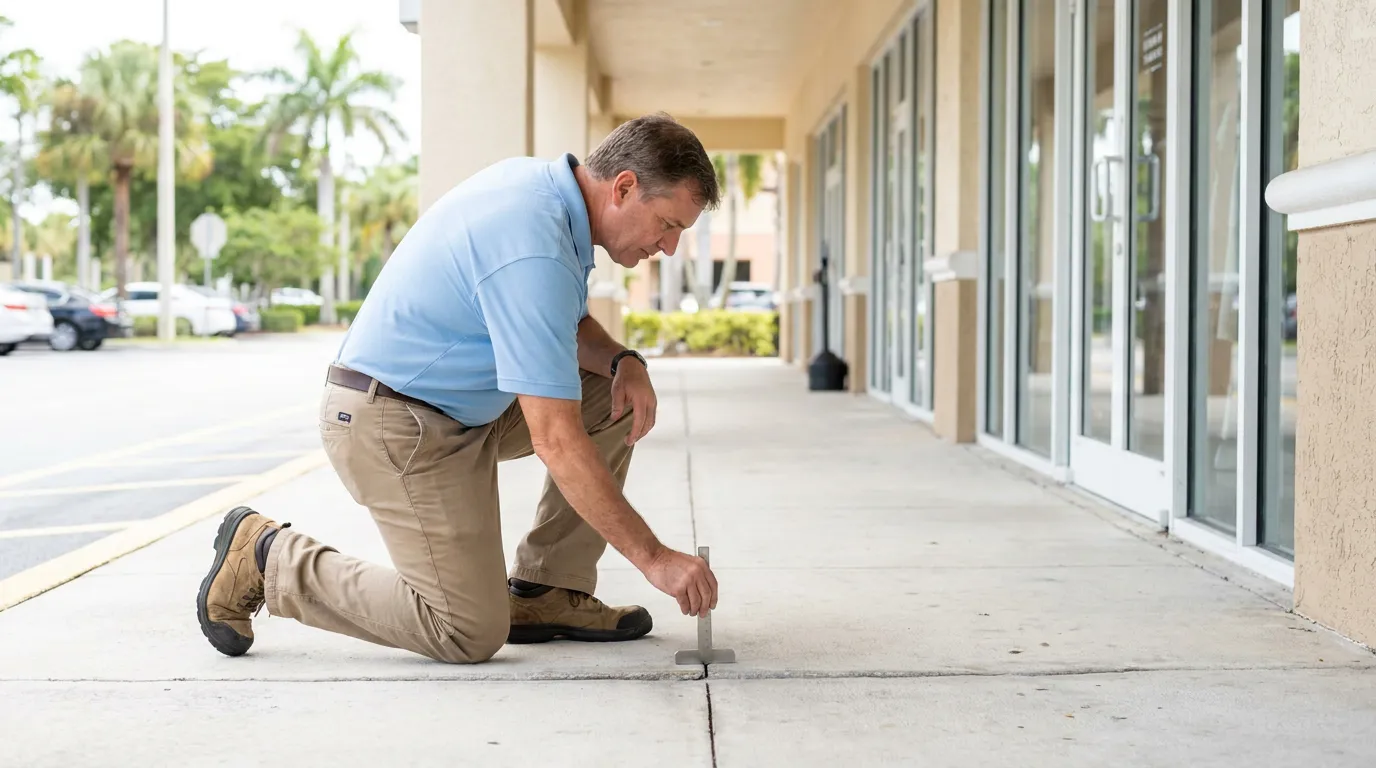
Understanding the ADA Trip Hazard 1/4 Inch Rule
The ada trip hazard 1/4 inch rule comes from federal ADA Standards governing changes in level on accessible walking surfaces.
The 1991 ADA Standards, section 4.5.2, provide that changes in level up to 1/4 inch may be vertical without edge treatment.
A small vertical lip, like a raised sidewalk slab, is generally permitted only up to a quarter inch before treatment is required.
This threshold is part of broader safety requirements for walking surfaces.
Under the 1991 ADA Standards, section 4.5.1, ground and floor surfaces along accessible routes must be stable, firm, and slip-resistant.
These requirements apply to interior and exterior routes, which is why Ft Lauderdale sidewalks, store approaches, and hotel walkways fall within the framework making a 1/4 inch trip hazard legally meaningful.
How Level Changes Are Measured Under ADA Sidewalk Standards
The ADA sets tiered thresholds determining how height differences must be handled. The Access Board’s guidance on floor and ground surfaces explains that
the standards address surface characteristics, carpeting, openings, and changes in level along interior and exterior accessible routes such as walking surfaces and ramps.
Review the full technical breakdown in the federal government’s overview of ADA sidewalk standards.
The Three Level-Change Thresholds
Three distinct thresholds govern surface change requirements. Each range triggers different owner obligations.
| Height of Level Change | Required Treatment |
|---|---|
| Up to 1/4 inch | May be vertical, no edge treatment needed |
| Between 1/4 inch and 1/2 inch | Must be beveled with a slope no steeper than 1:2 |
| Greater than 1/2 inch | Must be handled by a compliant ramp or curb ramp |
These figures reflect actual standards language.
The 1991 ADA Standards, section 4.5.2, state that changes between 1/4 inch and 1/2 inch must be beveled with a slope no greater than 1:2.
That section provides that changes greater than 1/2 inch must be accomplished by a ramp complying with sections 4.7 or 4.8.
Once a difference exceeds a half inch, it’s no longer a simple bevel but a full accessibility barrier.
Grates, Openings, and Other Surface Hazards
The ADA also addresses surface defects beyond level changes. Openings such as grates and drainage covers are regulated to prevent catching feet, canes, or wheelchair casters. According to federal guidance,
openings are limited in width to prevent passage of a 1/2 inch diameter sphere, and elongated openings must be oriented so the long dimension is perpendicular to the dominant travel direction.
These details matter in Ft Lauderdale trip and fall cases involving walkway grates.
Which Standard Applies to an Older Property
Not every property is measured against the same standards version. The applicable version depends on when the walkway was built or altered.
The Department of Justice adopted the 1991 ADA Standards, which governed new construction and alterations until March 14, 2012, and the 2010 ADA Standards became effective March 15, 2012.
Determining which standard applies can be fact-intensive, and courts may consider construction and alteration dates when evaluating ADA level change arguments.
Premises Liability and Uneven Pavement in Ft Lauderdale
Trips caused by uneven pavement are analyzed as premises liability claims rooted in negligence. Premises liability connects an ADA violation to your recovery rights. As a legal reference explains,
premises liability holds parties in control of property accountable for hazardous conditions that cause harm and is based on the concept of negligence.
Learn more about the framework in this overview of premises liability principles.
Property owners aren’t automatically responsible because a hazard existed. Injured persons must typically show the owner knew or should have known about the danger.
A plaintiff generally must show actual notice, or constructive notice meaning the hazard existed long enough that a reasonably careful owner should have discovered and fixed it.
An ADA measurement can support the argument that a defect required correction.
Certain conditions are recognized as classic trip-and-fall dangers:
- Uneven surfaces and raised sidewalk edges
- Broken or deteriorating floors and walkways
- Inadequate maintenance of stairs and handrails
- Unmarked or abrupt changes in elevation
These reflect commonly cited hazards in premises cases.
Uneven surfaces and inadequate maintenance, such as broken stairs or deteriorating floors, are recognized dangerous conditions in premises liability.
Whether any condition supports a claim depends on facts, so proving duty, breach, causation, and damages remains essential. See our discussion of what must be proven in a Ft Lauderdale trip and fall case.
💡 Pro Tip: If safe to do so, photograph the defect next to a coin or ruler before leaving the scene. A quarter is roughly the width that matters, and clear measurements can support arguments that the level change exceeded ADA thresholds.
Deadlines: Florida’s Statute of Limitations for Trip and Fall Claims
Florida law now gives injured people a shorter window to file negligence lawsuits. Sidewalk elevation injuries are treated as negligence claims, and timing is critical.
A 2023 amendment reduced the negligence statute of limitations from four years to two, applicable to causes of action accruing after March 24, 2023, under Section 28, chapter 2023-15.
These limitation periods are set in Florida’s statute governing time limits for civil actions.
The current deadline is generally two years from when the cause of action accrues.
Under Fla. Stat. §95.11 (2024), Florida sets limitation periods for actions including general negligence claims, and injured parties now generally have two years to file suit after the cause of action accrues.
Review the statutory text on the Florida Legislature’s page for the Florida negligence filing deadline. Courts interpret exceptions to these deadlines narrowly, and tolling or delayed-discovery arguments may apply only in limited circumstances. Civil filing deadlines are separate from administrative or governmental claim requirements that arise when public entities maintain sidewalks.
Protecting Your Claim After a Sidewalk Trip Hazard
Preserving evidence quickly often determines whether a claim is provable. Surfaces get repaired, footage gets overwritten, and memories fade. Taking timely steps protects the factual record a premises liability case requires.
Several actions can strengthen a potential claim:
- Report the incident to the owner or manager and request written records
- Preserve photos, videos, and measurements of the level change
- Identify witnesses and gather contact information
- Seek prompt medical care and keep treatment records
- Note the fall date to track the filing deadline
These steps support elements a court may consider. Because ADA measurements, notice, and causation can be technical, working with a knowledgeable slip and fall attorney Ft Lauderdale residents trust may help evaluate your claim’s strength. Outcomes depend on specific circumstances, and this article provides general information rather than individualized legal advice.
Frequently Asked Questions
1. Is a 1/4-inch sidewalk difference always a legal violation?
Not necessarily. Vertical changes up to a quarter inch are generally permitted without treatment, so defects at or below that height may not violate standards. Liability still depends on notice, causation, and other negligence elements.
2. What happens when a level change is more than 1/2 inch?
That size difference is treated seriously. Changes greater than 1/2 inch generally require compliant ramps rather than beveled edges, supporting arguments that dangerous barriers existed.
3. How long do I have to file a trip-and-fall lawsuit in Florida?
Generally two years from when the claim accrues. For causes of action accruing after March 24, 2023, the negligence limitations period was reduced from four to two years under Fla. Stat. §95.11 (2024). Exceptions are interpreted narrowly and may apply only in limited circumstances.
4. Does an ADA violation automatically prove my case?
No. ADA measurements provide strong evidence, but you must still prove the owner had actual or constructive notice and that the hazard caused your injury.
5. What if a city or public entity owns the sidewalk?
Different rules may apply. Claims against public entities can involve separate administrative notice requirements distinct from civil statutes of limitations, and these processes can be time-sensitive.
Taking the Next Step After an Uneven Pavement Injury
The ADA 1/4-inch trip hazard rule gives injured people a concrete benchmark for evaluating whether a walking surface was reasonably safe. When level changes exceed a quarter inch without beveling, or a half inch without a ramp, that measurement can support premises liability claims built on duty, breach, causation, and damages. Because Florida now generally allows only two years to file and evidence disappears quickly, acting promptly matters. Every situation is fact-specific, so careful review of your circumstances is the best way to understand your options.
If an uneven pavement injury has left you facing medical bills or lost wages, Chalik & Chalik Injury Lawyers is here to help you understand your rights. Call our team at 954-476-1000 or complete our confidential contact form to request a review of your slip and fall Ft Lauderdale Florida claim.


 Palm Beach County plans health fairs to reduce slip and fall accidents
In an effort to tackle the large number of slip and fall accidents reported in Palm Beach County, Florida, officials announced three senior health fairs in January. Palm Beach County Fire Rescue said 87 percent of the 911 calls they received in 2015 were regarding medical emergencies. The most common calls they responded to involved...
 What Duty of Care Does Miami Airport Owe Travelers on Wet Floors?
Understanding Your Rights After a Fall at Miami International Airport Key Takeaways: Miami International Airport and businesses within it owe travelers, classified as business invitees, a high duty of care to maintain safe walkways and warn of hazards. Under Florida’s transitory foreign substance statute, Fla. Stat. § 768.0755, injured travelers must prove the establishment had...
 What Happens If a Store Destroys Footage After a Plantation Fall?
When a Store Destroys Video Evidence After Your Plantation Fall If you slipped and fell in a Plantation store and discovered the surveillance footage was deleted, your case isn’t over. Under Florida law, destroying evidence (spoliation) triggers serious legal consequences. Courts recognize that stores may have a duty to preserve video recordings once aware a...
 Who Is Considered an Invitee Under Plantation Slip and Fall Law?
Understanding Your Rights as a Visitor on Florida Property Key Takeaways: If you were injured while shopping, dining, or visiting a business in Plantation, you were most likely an invitee under Florida law, a person invited onto property for a business purpose. Florida sorts visitors into three categories, invitee, licensee, and trespasser, each carrying different...
 What Should I Do If I Slip and Fall at a Marriott Hotel?
Slip and fall accidents don’t sound dangerous, but they can cause serious harm. If you’ve been injured in a fall at a Marriott hotel due to another’s negligence, your priority should be getting the medical assistance you need. Reporting your injury to the hotel owner or manager and identifying the cause of your fall can...
 Can I Sue a Cruise Ship If I’m Injured From a Fall?
You can sue a cruise ship if you’re injured in a fall onboard. When there is a fall hazard, something that causes a slip or trip, and you suffer injuries, the cruise company might be legally responsible. They must provide a safe environment for passengers and workers alike. If you fell on a cruise, you...
 Wet Floor Slip and Falls: What You Need To Know
If you were involved in a wet floor slip and fall accident, you should know that: If another party’s negligence caused your accident, you can seek compensation. You should collect any type of evidence possible to strengthen your case. Slip and fall accidents can cause severe injuries, so you should seek medical care right away....
 Slip and Fall Injury Lawyer Winn-Dixie Orlando
Slip and Fall Injury Lawyer Winn-Dixie Orlando: Holding Grocery Stores Accountable in Central Florida Orlando is a city built on movement. Between tourism, hospitality workers, commuters, and rapidly growing residential neighborhoods, grocery stores operate under nonstop pressure. Winn-Dixie locations across Orlando and Orange County are no exception. Stores along Colonial Drive, Orange Blossom Trail,...