
When a Brightline Train Kills a Pedestrian in Florida, Who Pays?
Key Takeaways:Under the Florida Wrongful Death Act, the train operator, maintenance companies, contractors, government entities, or other careless third parties may be liable for a Brightline pedestrian death, and more than one may share the blame. Railroads often argue the pedestrian was trespassing or broke the crossing stop rule in Fla. Stat. § 316.1575. Courts may still look at signals, horn use, train speed, and fencing. Under Florida’s modified comparative negligence rule, a party more than 50 percent at fault for their own harm generally cannot recover, so how fault is split can decide the case. The decedent’s personal representative files the claim under Fla. Stat. § 768.20 for the survivors and the estate. Damages may include lost support, companionship, mental pain and suffering, and medical or funeral costs. Families generally have two years to file, and claims against government entities have separate notice rules under Fla. Stat. § 768.28. Key evidence like event recorders and video can disappear quickly, so acting early helps protect a family’s options.
Who is responsible for a pedestrian death on the Brightline tracks depends on the facts, and more than one party may share the blame. Under Florida law, the railroad operator, a maintenance contractor, a government entity in charge of a crossing, or another careless party could be liable if their wrongful act or negligence caused the death. Railroads often respond that the pedestrian was trespassing or ignored warnings. That argument does not always end the case, though trespasser status can limit the duty a railroad owes. Investigators and courts may still look at signals, horn use, train speed, fencing, and crossing design. Federal law may limit some claims about speed or crossing warning devices.
If you lost a loved one in a train crash, you do not have to sort out these questions alone. The team at Chalik & Chalik Injury Lawyers helps grieving families understand their rights. Call 954-476-1000 or contact us now to talk about your family’s situation.
The Legal Basis for a Florida Pedestrian Death Claim
Florida wrongful death claims fall under the Florida Wrongful Death Act, Florida Statutes §§ 768.16 through 768.26.
The main liability rule is Fla. Stat. § 768.19. Under that statute, when a person’s death is caused by the "wrongful act, negligence, default, or breach of contract or warranty" of another, the party that would have been liable if the person had lived can be held liable for damages. Put simply, if the pedestrian could have sued had they lived, the family may be able to bring a wrongful death claim. You can read the full text in Florida’s wrongful death statutes.
Who Can Be Named in a Train Accident Case
Train accident cases often involve more than one possible defendant. Depending on the facts, a family might look into:
- The train operator: In cases involving speed, horn use, lookout, or crew conduct
- Track and signal maintenance companies: If gates, lights, or bells failed or were not kept up
- Contractors: If construction or repair work created a hazard near the tracks
- Government entities: When crossing design or road conditions played a role. These claims come with immunity limits, damage caps, and notice rules under Fla. Stat. § 768.28
- Drivers or other third parties: If their conduct pushed a pedestrian into danger
Each possible defendant may have its own legal rules and defenses. Before suing a Florida government entity, a family generally must send written notice to the agency and, in most cases, to the Department of Financial Services. Federal railroad safety law may also block some state-law claims. Finding every responsible party early can affect how much a family may recover.
Why Brightline Pedestrian Death Cases Often Turn on Fault
When a Brightline train kills a pedestrian, fault often becomes the main fight. Railroads commonly argue that the pedestrian was trespassing, distracted, or ignored warnings. Under Florida’s modified comparative negligence rule in Fla. Stat. § 768.81(6), a party found more than 50 percent at fault for their own harm generally cannot recover any damages. If the pedestrian’s share is 50 percent or less, damages are reduced by that percentage.
How this rule works when the defense blames the person who died is not simple. The statute speaks of a party’s fault for "his or her own harm," and how courts apply that language in wrongful death cases can depend on case law and the facts. The rule also does not apply to some cases, such as medical negligence claims.
The Crossing Stop Rule Railroads Rely On
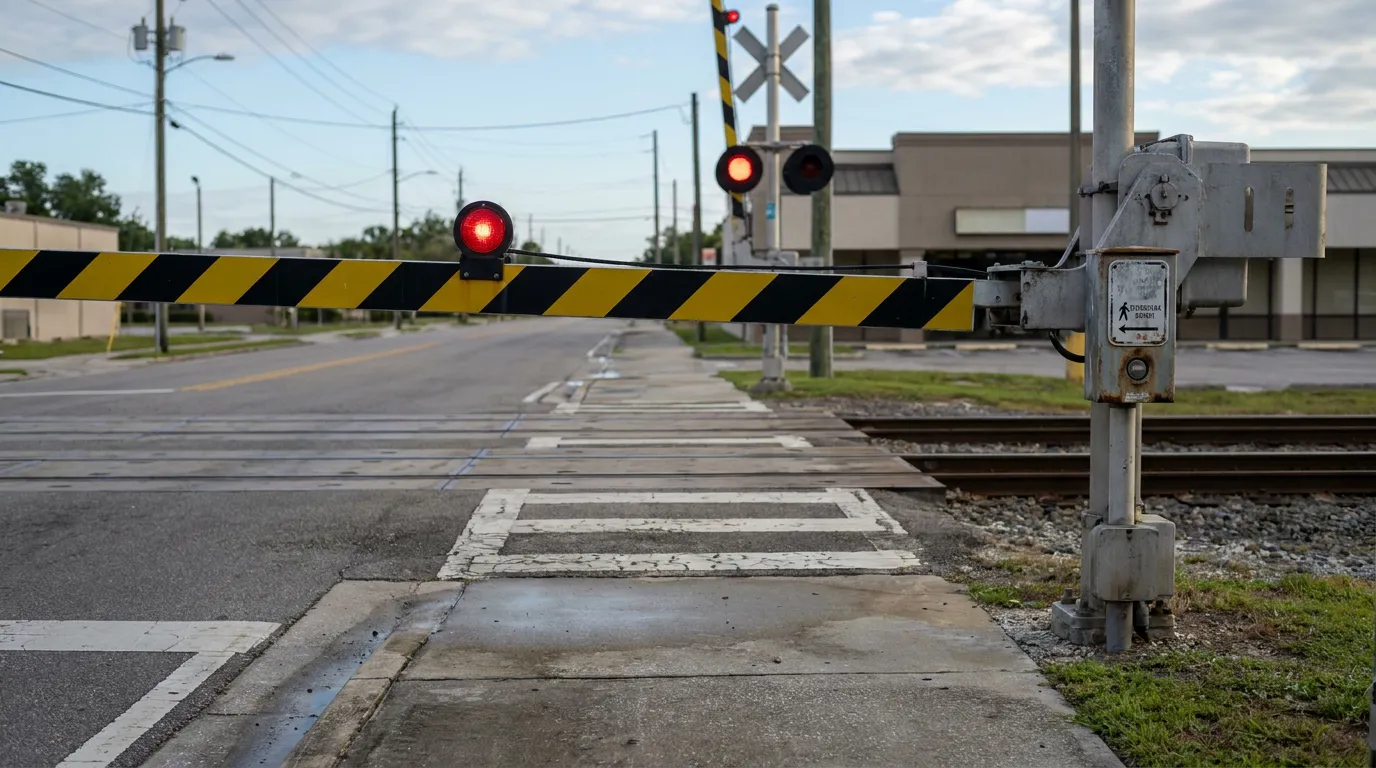
Fla. Stat. § 316.1575(1) generally requires anyone walking, biking, or driving toward a railroad crossing to stop between 15 and 50 feet from the nearest rail when certain warnings are present. Those warnings include flashing signals, lowered gates, a flagger, a train horn, or a train that is clearly visible and close enough to be a hazard. The person may not go on until it is safe, and may never go through, around, or under a lowered gate. Railroads often point to breaks of this rule to argue the pedestrian caused the crash.
A possible violation by the pedestrian does not automatically erase the railroad’s duties. Courts may consider whether the signals worked, whether the horn sounded properly, whether the train was going a safe speed, and whether fencing or barriers were adequate. Federal rules, such as FRA track speed limits and federally funded crossing warning devices, may limit some of these theories. These failures may shift a real share of fault back to the railroad or other defendants.
💡 Pro Tip: As soon as you can, write down everything witnesses told you, such as whether the gates came down or a horn sounded. Memories fade fast, and these details can later be checked against signal and train data.
Who Files the Claim and Who Can Recover
Under Fla. Stat. § 768.20, the decedent’s personal representative brings the wrongful death case, not individual family members. The personal representative seeks damages for the survivors and the estate. When an injury causes death, any personal injury claim the pedestrian had ends and the wrongful death claim takes its place.
One survivor’s own conduct generally affects only that survivor’s recovery. Section 768.20 says a defense that would bar or reduce one survivor’s recovery may be raised against that survivor but does not affect any other survivor. Under Fla. Stat. § 768.21, the complaint must name the decedent’s survivors and the estate and state how each survivor was related to the decedent.
Damages Available Under Fla. Stat. § 768.21
Florida law separates damages for survivors from damages for the estate.
| Who Recovers | Possible Damages |
|---|---|
| Each survivor | Value of lost support and services, past and future |
| Surviving spouse | Loss of companionship and protection; mental pain and suffering |
| Minor children (and all children if no surviving spouse) | Lost parental companionship, instruction, and guidance; mental pain and suffering |
| Parents of a deceased minor child (or of an adult child with no other survivors) | Mental pain and suffering |
| Survivor who paid expenses | Medical or funeral expenses |
| The estate | Lost earnings from injury to death; prospective net accumulations in some cases; medical or funeral expenses charged to the estate |
Whether a family qualifies for each type depends on relationships, ages, and finances. For example, "prospective net accumulations" are generally limited to cases where the survivors are a spouse or lineal descendants, or where the decedent was an adult with no survivors.
The Two-Year Deadline for a Florida Pedestrian Death Claim
Fla. Stat. § 95.11(5)(e) generally requires a wrongful death case to be filed within two years of the date of death. Negligence cases generally have the same two-year limit under Fla. Stat. § 95.11(5)(a).
Exceptions to filing deadlines are rare, and courts generally read them narrowly. For wrongful death claims against Florida government entities, Fla. Stat. § 768.28(6) generally requires written notice within two years. The agency must then have time to review the claim before a lawsuit can be filed, so acting early protects more options.
Gathering Evidence After a Brightline Pedestrian Death
After a Brightline pedestrian death, key evidence can disappear quickly. Train event recorders, forward-facing video, signal maintenance logs, crew radio calls, and nearby security footage may be erased or lost if no one acts to save them. Early letters asking parties to preserve evidence can help keep this material available.
Federal data can help put a single crash in context. The Federal Railroad Administration oversees railroad safety reporting, and its records track highway-rail grade crossing incidents and trespasser casualties by state and county. These records may show patterns at a crossing, though they do not prove fault in any one case.
💡 Pro Tip: Ask for a copy of the police report, and keep every letter or call from the railroad or any insurer in one folder. Do not give recorded statements before you understand your rights.
Reading about similar cases can help families before they act. Reviewing information on a Florida pedestrian death claim can help you prepare questions for a lawyer.
Frequently Asked Questions
-
Can a family sue if the pedestrian was on the tracks illegally?
Possibly, depending on the facts. Trespassing can limit the duty a railroad owes, and Fla. Stat. § 768.81(6) generally bars recovery by a party more than 50 percent at fault for their own harm. The railroad’s conduct, including signals, horn use, and fencing, may still be examined.
-
Who files the wrongful death lawsuit?
The decedent’s personal representative files it under Fla. Stat. § 768.20. That person seeks recovery for the survivors and the estate.
-
How long does a family have to file?
Generally two years from the date of death under Fla. Stat. § 95.11(5)(e). Claims against government entities require notice before suit under Fla. Stat. § 768.28, and exceptions are rare.
-
Can adult children recover damages?
If there is no surviving spouse, adult children may be able to recover for lost parental companionship, instruction, guidance, and mental pain and suffering. This rule comes from Fla. Stat. § 768.21. In medical negligence cases, adult children cannot recover these damages.
-
Are funeral costs recoverable?
Generally yes. Under Fla. Stat. § 768.21, a survivor who paid medical or funeral costs may be able to recover them. The estate may also recover those costs if they were charged to it.
Holding Careless Parties Accountable After a Train Death
Who pays after a Brightline train kills a pedestrian depends on the evidence, the conduct of every party involved, and how Florida’s comparative fault rules apply. The Florida Wrongful Death Act lets the personal representative seek damages for survivors and the estate, generally within two years of the death. Speaking with a Brightline pedestrian killed lawyer can help your family understand its options.
Your family deserves real answers about what happened.Chalik & Chalik Injury Lawyers works with Fort Lauderdale families after the loss of a loved one in a pedestrian crash. Call 954-476-1000 or schedule your consultation today to start protecting your rights.
Disclaimer: This content is for general information only and is not legal advice. Every case is different, and results may vary. Talk to a lawyer about your own situation.
 When Must a Wrongful Death Notice Be Filed for a Miami Airport Death?
Understanding Deadlines for a Miami Airport Wrongful Death Claim Key Takeaways: A wrongful death claim from a death at Miami International Airport must generally be filed within two years. Because the airport is operated by Miami-Dade County, a pre-suit notice of claim under Fla. Stat. § 768.28 must be served on the agency before filing...
 Midair Collision of Two Excursion Planes Carrying Princess Cruises Passengers Raises Questions About Liability
A midair collision of two floatplanes carrying Princess Cruises passengers caused the deaths of six people on Monday, May 13, 2019. All passengers were guests of the Princess Cruises’ Royal Princess cruise ship. One of the planes involved in the crash, an Otter plane operated by Taquan Air, carried 10 passengers on a shore excursion....
 Chalik & Chalik Represent Victims of Surfside Condo Collapse
Updated on July 9, 2021 Early on June 24, 2021, the right wing of Champlain Towers South condominium collapsed, leaving dozens injured and at least 60 people dead. The death toll may continue to rise as recovery efforts continue, with 80 people still unaccounted for, according to Local 10 News. Chalik & Chalik has filed...

Understanding When Florida Bars Face Responsibility After a Fatal Crash Key Takeaways: Under Florida law, bars serving alcohol to legal-age adults generally cannot be held liable for drunk driving deaths, making Florida’s dram shop statute among the nation’s most restrictive. Two narrow exceptions exist under Florida Statutes Section 768.125: willfully serving minors under 21, or...

A surviving family member can sue for wrongful death after a car accident in Florida by filing a lawsuit in a civil court. Before filing the claim, the family member must gather evidence to support the claim, prove liability, determine the value of their claim, meet the statute of limitations, and then file their claim...

The personal representative of the decedent’s estate is eligible to file a wrongful death claim in Florida. They would file the claim to benefit the estate and the decedent’s survivors as defined by Florida law. The loss of a family member can cause emotional upheaval. It can also lead to unexpected expenses and significant economic...

If your family lost a loved one due to someone else’s negligence, the personal injury damages they could have sued to recover survive their demise. Your family could receive these damages in a survival action. However, wrongful death damages compensate specific family members for the financial expenses and losses they experience after a loved one...

Several of the most common causes of fatalities on cruise ships could occur because of the negligence of the cruise line or ship staff. Many accidents and incidents occur onboard ships because of unsafe premises, inadequate staff training, or negligent operation of the vessel. If you lost a loved one in a fatal cruise accident,...