
Understanding Deadlines for a Miami Airport Wrongful Death Claim
Key Takeaways:A wrongful death claim from a death at Miami International Airport must generally be filed within two years. Because the airport is operated by Miami-Dade County, a pre-suit notice of claim under Fla. Stat. § 768.28 must be served on the agency before filing suit. Missing either deadline can permanently bar a valid claim. The claim is governed by the Florida Wrongful Death Act (Chapter 768) and must be brought by the decedent’s personal representative on behalf of the estate and statutory survivors. Recoverable damages may include lost support, services, and for minor children, lost parental companionship and mental pain and suffering, though recovery against a government entity is capped by statute. Preserving evidence such as incident reports, security footage, and witness statements early is critical. Families should seek qualified legal guidance promptly to protect their right to recover.
A wrongful death claim from a death at Miami International Airport requires action within strict timeframes, and in most cases you must serve written pre-suit notice on the government before filing suit. Because Miami International Airport is operated by Miami-Dade County, a fatal incident there may trigger Florida’s sovereign immunity rules in addition to the wrongful death statute. Two separate clocks run simultaneously: the civil filing deadline and the government notice-of-claim deadline. Missing either can permanently bar your claim.
Understanding these overlapping rules is difficult during grief, which is why families often seek guidance quickly. The deadlines are unforgiving, and courts interpret exceptions narrowly. If your family lost a loved one in an airport accident, you can reach Chalik & Chalik Injury Lawyers, a trusted Miami airport injury lawyer team, by calling 954-476-1000 or using the firm’s online case review request to discuss your options.
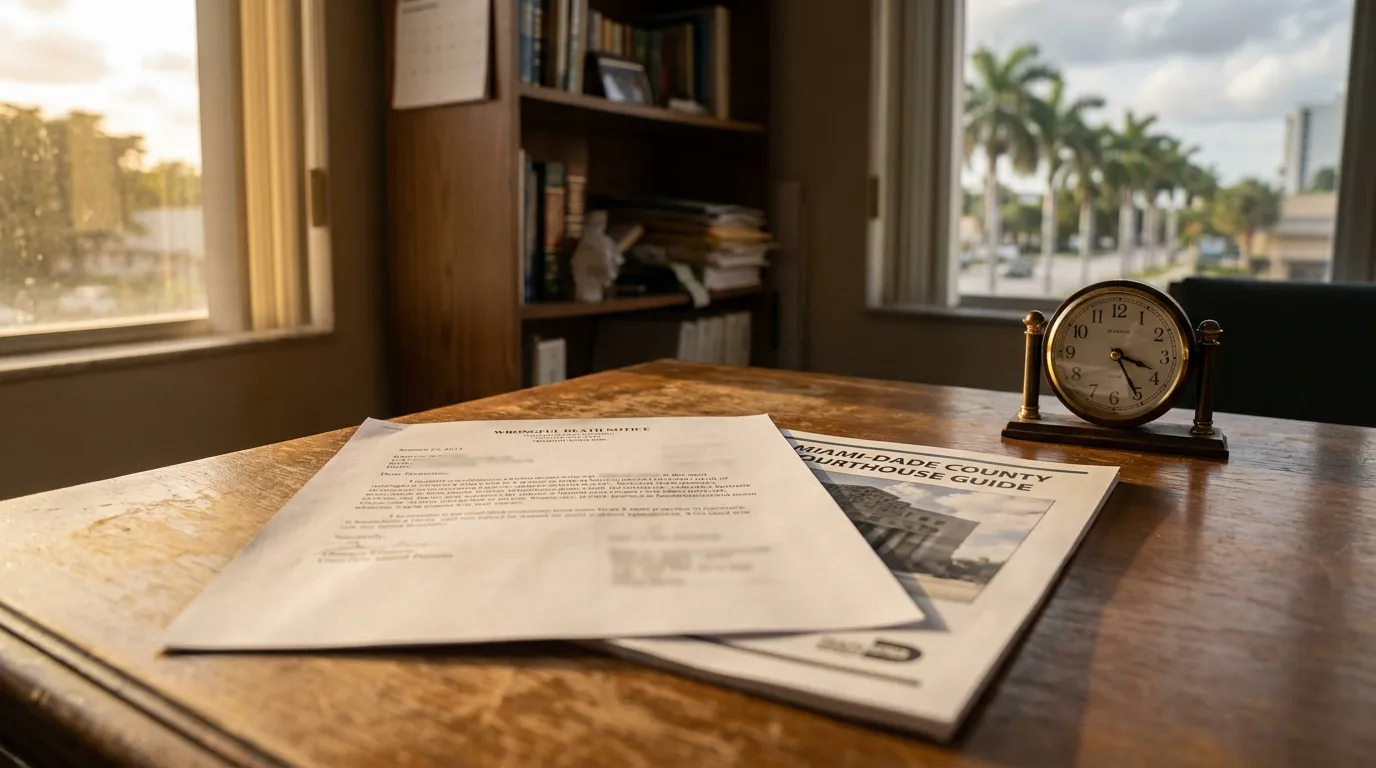
Why the Florida 768.28 Notice of Claim Applies at Miami International Airport
The florida 768.28 notice of claim requirement applies because Miami International Airport is a public facility operated by Miami-Dade County. When a death results from government negligence, Florida law requires specific pre-suit steps before allowing a lawsuit.
Under Florida’s limited waiver of sovereign immunity, a claimant must serve written notice of the claim before suing the state or its subdivisions. This rule is codified in Fla. Stat. § 768.28. Specifically, Fla. Stat. § 768.28(6) sets out the pre-suit written notice requirement, and Fla. Stat. § 768.28(14) addresses limitations on when such claims may be brought. You can review the statutory text through the Florida Legislature’s official publication of the Florida Wrongful Death Act statutes.
The notice must be presented in writing to the appropriate agency before suit is filed. Because Miami International Airport is operated by Miami-Dade County, a county subdivision, the additional requirement to notify the Florida Department of Financial Services does not apply, only the agency notice to Miami-Dade County is required. After proper notice is served, a claimant generally must also allow the agency up to 180 days to review the claim before filing suit. If the notice step is skipped or served incorrectly, a court may dismiss the case regardless of the underlying facts.
How the Florida Wrongful Death Act Governs Your Claim
The Florida Wrongful Death Act supplies the legal framework for any fatal airport incident in Miami-Dade, whether the death arose from a fall, a shuttle collision, or another hazard. The Act is codified in Chapter 768 of the Florida Statutes, specifically sections 768.16 through 768.26.
What Counts as a Wrongful Death
A wrongful death occurs when a person dies because of another party’s wrongful act, negligence, default, or breach of contract or warranty. Fla. Stat. § 768.19 defines when this cause of action arises. In the airport context, this can include a fatal fall on a wet or damaged terminal floor, a moving-walkway or escalator failure, or an on-airport vehicle collision.
Damages Available to Survivors
The Act identifies specific categories of damages that survivors and the estate may recover. Fla. Stat. § 768.21 addresses recoverable damages, which may include lost support and services and, for minor children, lost parental companionship along with mental pain and suffering. However, when Miami-Dade County is the defendant, Fla. Stat. § 768.28 generally caps recovery at $200,000 per person and $300,000 per incident, absent a separate legislative claim bill.
Timelines: The Two-Year Deadline and Notice Requirements
For most Florida wrongful death actions, the personal representative must file suit within two years, and the government notice requirement runs alongside that civil deadline when a public entity is involved. The civil statute of limitations governs when a lawsuit must be filed, while the government administrative notice requirement under Fla. Stat. § 768.28 governs what must happen before a lawsuit against a subdivision like Miami-Dade County is permitted.
Families sometimes assume that a discovery rule or tolling provision will automatically extend these deadlines, but that assumption is risky. Courts interpret tolling and delayed-discovery exceptions narrowly, and they apply only in limited circumstances. The safest approach is to identify every applicable deadline early.
The following table summarizes the distinction between these two obligations:
| Requirement | Governing Authority | General Purpose |
|---|---|---|
| Civil filing deadline | Florida Wrongful Death Act, Chapter 768 | Sets the window to file the lawsuit |
| Government notice of claim | Fla. Stat. § 768.28(6), (14) | Pre-suit notice to the agency before suing a county subdivision |
Missing the pre-suit notice step can be fatal to a claim even if the civil filing window is still open.
Who Must File the Miami-Dade Airport Death Claim
A wrongful death action must be brought by the decedent’s personal representative on behalf of the estate and all statutorily defined survivors. Fla. Stat. § 768.20 vests the right of action in the personal representative, who pursues a single action for the mutual benefit of the survivors and the estate. All potential beneficiaries must be identified in the complaint, as reflected in Fla. Stat. §§ 768.20 and 768.21.
Individual family members generally do not file separate lawsuits for the same death. Identifying the correct personal representative and every eligible survivor early helps avoid procedural problems. Before taking any step, it is wise to understand what to do after an airport injury so that important rights are not unintentionally waived.
When a death occurs during existing litigation, Florida also imposes procedural duties on those who know about it. Florida Rule of Civil Procedure 1.260(a)(1) sets forth the procedure when a party dies during a case, and courts have held that the legal representative with knowledge of a pending suit "has the duty to inform the attorneys of record of the decedent’s death." As one Florida Bar Journal discussion of a litigant’s death during a case explains, failing to react timely can create serious consequences.
Preserving Evidence After a Fatal Airport Incident
Strong wrongful death claims depend on evidence that can disappear quickly, so preservation should begin immediately. Airport environments are heavily monitored, which means useful proof often exists but may be overwritten or lost if no one acts. Establishing negligence requires showing duty, breach, causation, and damages.
Consider preserving the following categories of evidence:
- Incident reports and any airport or airline internal records
- Security camera footage from terminals, walkways, or parking areas
- 911 records, police reports, and emergency response documentation
- Medical records and, where relevant, the medical examiner’s findings
- Names and statements of witnesses who saw the incident
Complex airport cases often involve multiple potentially responsible parties, including the county operator, airlines, contractors, and vendors. In many cases, expert testimony is needed to reconstruct how the incident happened and to connect the hazard to the death.
💡 Pro Tip: Send written preservation requests early. Once a government entity or contractor is on notice that footage matters, it becomes harder for that evidence to be routinely deleted.
Frequently Asked Questions
-
Does every airport death claim require a 768.28 notice of claim?
Not necessarily, the requirement depends on whether a government entity is a responsible party. A 768.28 wrongful death notice generally applies when a subdivision like Miami-Dade County is potentially liable. If only private parties are involved, the sovereign immunity notice rules may not apply.
-
How long do I have to file a Miami airport wrongful death claim?
Most Florida wrongful death lawsuits must be filed within two years. When a public entity is involved, a separate notice-of-claim step under Fla. Stat. § 768.28 must generally be completed first, and the agency’s review period must run before suit is filed. Confirming deadlines early is important.
-
Can the two-year deadline in Florida ever be extended?
In limited circumstances, certain tolling or discovery principles may affect timing, but courts apply them narrowly. For claims against a government entity, the required pre-suit notice period can also toll the limitations clock, but no extension should be assumed automatic. The safest approach is to treat the earliest possible deadline as controlling.
-
Who is allowed to bring the wrongful death lawsuit?
The decedent’s personal representative brings a single action for the survivors and the estate. Under Fla. Stat. § 768.20, individual relatives generally do not file separate suits. All eligible beneficiaries must be named in the complaint.
-
What if the airport operator disputes responsibility?
Disputes over sovereign immunity in Florida and over which party is responsible are common in airport cases. Establishing negligence still requires proof of duty, breach, causation, and damages. Outcomes depend on the specific facts and evidence gathered.
Protecting Your Family’s Right to Recover
A death at Miami International Airport can involve both the Florida Wrongful Death Act and the government notice requirements of Fla. Stat. § 768.28, and both must be handled together. The florida 768.28 notice of claim step, the two-year civil deadline, the identification of the correct personal representative, and the preservation of airport evidence all work in tandem. Because courts read exceptions narrowly and deadlines strictly, acting promptly protects the family’s ability to pursue a Miami-Dade airport death claim. Every case turns on its own facts, and nothing here is a substitute for individualized legal guidance.
If your family is facing this situation, timely action can make a meaningful difference. Reach out to Chalik & Chalik Injury Lawyers, a firm respected for handling airport accidents in Miami, Florida, by calling 954-476-1000 or by submitting a confidential case evaluation request to learn how the notice and filing deadlines may apply to your claim.
 Is Florida’s Free Kill Law Still in Effect in 2026 for Ft Lauderdale Families?
Where Florida’s Medical Malpractice Wrongful Death Rule Stands Today Key Takeaways: Florida’s "free kill" law generally remains in effect as of 2026, because § 768.21(8) stays on the books after HB 6003 passed the House 88-17 but died in the Senate, following Governor DeSantis’s May 29, 2025 veto of the prior repeal, HB 6017. The...

Understanding When Florida Bars Face Responsibility After a Fatal Crash Key Takeaways: Under Florida law, bars serving alcohol to legal-age adults generally cannot be held liable for drunk driving deaths, making Florida’s dram shop statute among the nation’s most restrictive. Two narrow exceptions exist under Florida Statutes Section 768.125: willfully serving minors under 21, or...
 Midair Collision of Two Excursion Planes Carrying Princess Cruises Passengers Raises Questions About Liability
A midair collision of two floatplanes carrying Princess Cruises passengers caused the deaths of six people on Monday, May 13, 2019. All passengers were guests of the Princess Cruises’ Royal Princess cruise ship. One of the planes involved in the crash, an Otter plane operated by Taquan Air, carried 10 passengers on a shore excursion....
 Chalik & Chalik Represent Victims of Surfside Condo Collapse
Updated on July 9, 2021 Early on June 24, 2021, the right wing of Champlain Towers South condominium collapsed, leaving dozens injured and at least 60 people dead. The death toll may continue to rise as recovery efforts continue, with 80 people still unaccounted for, according to Local 10 News. Chalik & Chalik has filed...

Florida’s wrongful death statute of limitations generally gives you two years to file your lawsuit. It’s understandable how the loss of a loved one can leave your family in emotional turmoil and uncertain of its next steps, making meeting the state’s filing deadline challenging. However, it is not a task you must handle without legal...

The personal representative of the decedent’s estate is eligible to file a wrongful death claim in Florida. They would file the claim to benefit the estate and the decedent’s survivors as defined by Florida law. The loss of a family member can cause emotional upheaval. It can also lead to unexpected expenses and significant economic...

A surviving family member can sue for wrongful death after a car accident in Florida by filing a lawsuit in a civil court. Before filing the claim, the family member must gather evidence to support the claim, prove liability, determine the value of their claim, meet the statute of limitations, and then file their claim...

If your family lost a loved one due to someone else’s negligence, the personal injury damages they could have sued to recover survive their demise. Your family could receive these damages in a survival action. However, wrongful death damages compensate specific family members for the financial expenses and losses they experience after a loved one...